

If you run an online store, you know this moment. You open your ad account, stare at a wall of audience settings and bid adjustments, and wonder how anyone has time left to run a business. That frustration is exactly why ai ads for ecommerce have become the default way stores advertise in 2026.
Instead of you hand-building every audience and guessing every bid, AI systems now handle the heavy lifting: finding likely buyers, setting bids in real time, and mixing creative until the best-performing combination wins. But “let the AI handle it” is not a strategy by itself.

AI Ads for Ecommerce: What They Actually Are
An AI ad is any paid advertisement where artificial intelligence makes key decisions that a human media buyer used to make. Those decisions include who sees the ad, when they see it, how much you bid for their attention, and which version of the ad they get.
Think of it this way. In traditional advertising, you were the pilot, adjusting every dial yourself. With AI ads, you set the destination and rules, and the system flies the route, adjusting thousands of times a day.
The term covers a few things working together:
- Automated targeting: the system finds people likely to buy, based on behavior signals, rather than relying only on the interests you pick.
- Smart bidding: bids rise or fall in real time depending on how likely a click is to become a sale.
- AI-mixed creative: headlines, images, and product shots are combined and tested automatically, and in some cases generated from your product photos.
- Budget optimization: spend shifts toward the audiences, placements, and products that are actually producing revenue.
For ecommerce specifically, AI ads lean heavily on your product catalog. Your feed of products, prices, and images becomes the raw material for dynamic ads that follow shoppers with items they actually viewed.
The simple way to remember it: you bring the products and the goal. The AI brings the math.
How AI Ads Work Behind the Scenes
You do not need a data science degree to use AI ads, but understanding the basic loop helps you decide better. Here is what happens after you launch a campaign.
Step 1: You feed the system your data
The cleaner this data is, the smarter the system gets. A store with sloppy product titles and broken tracking is asking the AI to drive with a foggy windshield.
Step 2: The system predicts who will buy
Machine learning models score millions of potential shoppers from signals like browsing behavior, purchase history, device, time of day, and similarity to your existing customers. Someone who viewed three pairs of running shoes this week scores far higher than a casual scroller, and your ads reach the high scorers first.
Step 3: Bids adjust in every auction
Every ad impression is an auction that lasts milliseconds. The AI decides what that specific impression is worth to you based on the predicted chance of a sale and its value. A likely buyer on payday weekend might be worth a $2 bid; a low-intent visitor at 3 a.m., maybe 20 cents. No human could make these calls at scale.
Step 4: Creative gets tested and rotated automatically
Upload several headlines, images, and videos, and the system mixes them into combinations, shows each one, measures the response, and gradually favors the winners.
On Google, this is the core idea behind Performance Max campaigns, which pull from your asset groups and product feed to build ads across Search, YouTube, Display, and more. Google explains the model in its official Performance Max documentation.
Step 5: The loop never stops learning
Every click, cart, and purchase flows back into the model. Over days and weeks, targeting sharpens, bids get smarter, and weak creative gets quietly retired. This is why AI campaigns often improve after a shaky first week, and why constantly restarting them can hurt.
Why Stores Are Switching: The Real Benefits
AI ads are not popular just because they are trendy. They solve real pain points, especially for stores without a full-time media buyer.
Time back in your week. Setup that once took days of audience building now takes an afternoon, and management shrinks from daily tweaking to weekly check-ins.
Reach you would never find manually. The system surfaces buyer pockets you would never think to target, such as a gift-buying segment that converts surprisingly well for your niche.
Faster creative testing. Instead of running one ad and hoping, you test dozens of combinations at once and let the data pick the winner.
Budgets that follow revenue. Spend flows toward products and audiences producing sales, instead of being locked into equal splits you set weeks ago.
AI Ads vs Manual Ads: A Side-by-Side Look
Here is how the two approaches compare on the jobs that matter most.
| Task | Manual Ads | AI Ads |
|---|---|---|
| Audience targeting | You pick interests, demographics, and lookalikes | System finds buyers from behavior signals and your customer data |
| Bidding | You set bids and adjust them by hand | Real-time bidding per impression, based on predicted conversion value |
| Creative testing | A few ads tested one at a time | Many combinations tested and rotated automatically |
| Budget allocation | Fixed splits you review periodically | Spend shifts continuously toward what is selling |
| Time required | Hours every week, ongoing | Setup plus weekly monitoring and steering |
| Control level | High, but limited by your time | Less granular, depends on quality of your inputs |
| Best for | Tiny budgets, very niche products, full manual control | Growing catalogs, repeat testing, stores short on time |
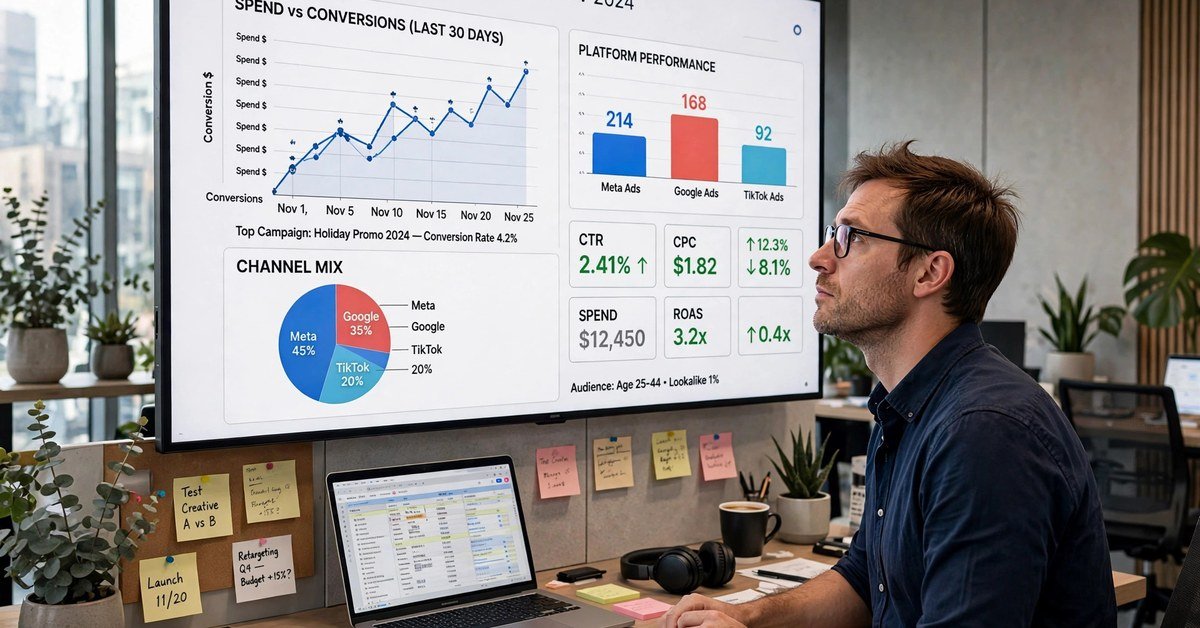
Most successful stores mix both: AI campaigns for scale and prospecting, manual control for brand protection, promotions, and bold creative ideas the AI would never invent.
How to Use AI Ads for Your Store in 2026
The stores getting real returns follow a pattern. Here is the playbook, step by step.
1. Fix your tracking first
AI is only as good as the signals it receives. Make sure purchase tracking fires correctly, values are accurate, and your platform sees add-to-cart and checkout events. Bad data in means bad decisions out.
2. Clean up your product feed
Your catalog is the AI’s raw material. Use clear product titles with the words shoppers actually search for, accurate prices and availability, and high-quality images.
3. Give the creative room to work
Upload a genuine variety of assets: different angles, lifestyle shots, short videos, and several headline angles. The system can only test what you give it. Five near-identical images produce near-identical results.
4. Set a goal the machine can aim at
Decide what one campaign is for: profitable sales, new customer acquisition, or clearing a specific product line. Point the bidding at a return target that reflects your real margins. If the target is impossible, the system barely spends, and you wrongly conclude AI ads do not work.
5. Pair ads with a store that converts
An AI can deliver the perfect shopper to your product page, but it cannot fix a slow page or unanswered questions. Quick support, for instance through an AI chatbot for ecommerce, can catch the questions that stop a ready buyer from checking out.
6. Let campaigns learn before you judge
Resist the urge to rebuild everything after two slow days. AI campaigns need a learning window with stable budgets and enough conversions to find their footing. Judge on a full week or two of data, not one bad afternoon.
If managing all of this feels like too much, that is exactly the gap that structured ecommerce marketing services exist to fill: the strategy and setup handled for you, with the AI doing the repetitive execution.
What AI Ads Cost (and What Budget You Actually Need)
There is no separate price tag for “AI.” You pay per click or per thousand impressions, set by the auction, and the AI features are built into platforms like Meta and Google at no extra license fee. What changes is how budget behaves:
- Small stores often start around $20 to $50 a day on one platform to gather enough conversion data for the learning loop.
- Growing stores commonly run $100 to $500 a day across prospecting and retargeting once a setup proves profitable.
- The hidden cost is creative. Fresh images and videos matter more in an AI system, because the machine burns through combinations quickly.
A useful rule of thumb: if your budget cannot generate at least a handful of sales per week in a campaign, the AI has too little signal to optimize. Consolidate into fewer campaigns until volume grows.
Also remember that ads are only one channel. Stores that pair AI ads with steady organic growth, for example through solid ecommerce SEO services, or that win back past buyers through an ecommerce email marketing agency, depend less on auction prices they cannot control.

Common Mistakes That Quietly Waste Ad Spend
AI ads forgive a lot, but these errors still drain budgets:
- Judging too early. Killing a campaign on day two, then restarting and paying for the learning period all over again.
- Starving the creative. Running the same two images for three months while performance fades. Ad fatigue hits AI campaigns too.
- Feeding broken tracking. Optimizing toward add-to-carts because purchase events are misconfigured, so the system finds you world-class window shoppers.
- Setting fantasy targets. Demanding a return your margins cannot support, then blaming the platform when spend stalls.
- Ignoring the product page. Pouring budget into traffic while the page loads slowly and hides shipping costs until checkout.
- Too many tiny campaigns. Splitting a modest budget across twelve campaigns means none gather enough data to learn.
AI Ads for Ecommerce: Frequently Asked Questions
Are AI ads worth it for a small store?
Yes, in most cases, especially if your time is the bottleneck. AI handles targeting and bidding work a small team cannot do manually. Start with one platform, one consolidated campaign, and a budget that can produce a few sales a week, then scale what works.
Do AI ads replace a marketing person or agency?
No. They replace repetitive execution, not judgment. Someone still needs to set strategy, produce creative, watch margins, and pick which products deserve promotion. AI makes a good marketer faster; it does not make strategy unnecessary.
How long do AI ad campaigns take to start working?
Expect a learning period of roughly one to two weeks, depending on your sales volume. Judge performance on trends over that window rather than daily swings, and avoid big budget changes mid-learning.
Which platform is best for AI ads in ecommerce?
It depends on your product. Meta’s AI-driven campaigns suit visual, impulse-friendly products and retargeting. Google’s AI campaigns capture shoppers actively searching and comparing. Many stores run both: Google for high-intent demand, Meta for discovery.
Can AI write my ad copy and make my images?
Platforms can generate and remix copy, headlines, and image variations from your assets, and the results are improving fast. Treat AI output as a strong first draft: check claims, prices, and brand voice before anything goes live.
What is the biggest risk with AI ads?
Handing over control without watching the inputs. If your feed, tracking, or margins are wrong, the AI efficiently optimizes toward the wrong outcome. Regular check-ins on data quality and profitability keep that risk small.
The Bottom Line
AI ads for ecommerce are not magic, and they are not a fad either. They are the new default machinery of online advertising: systems that find buyers, set bids, and test creative faster than any human team could.
Your job as a store owner has not disappeared. It has moved up a level: feed the system clean data and strong creative, set honest targets based on your margins, and give campaigns time to learn.
Do that, and AI stops being a buzzword in your ad account and starts being what it should be: a tireless assistant that helps the right shoppers find your products.

Muhammad Talha breaks down complex AI tools into simple, step-by-step guides for e-commerce entrepreneurs. His goal: to help you work smarter, not harder, by leveraging artificial intelligence
1 thought on “AI Ads for Ecommerce: How They Work and How to Use Them in 2026”