
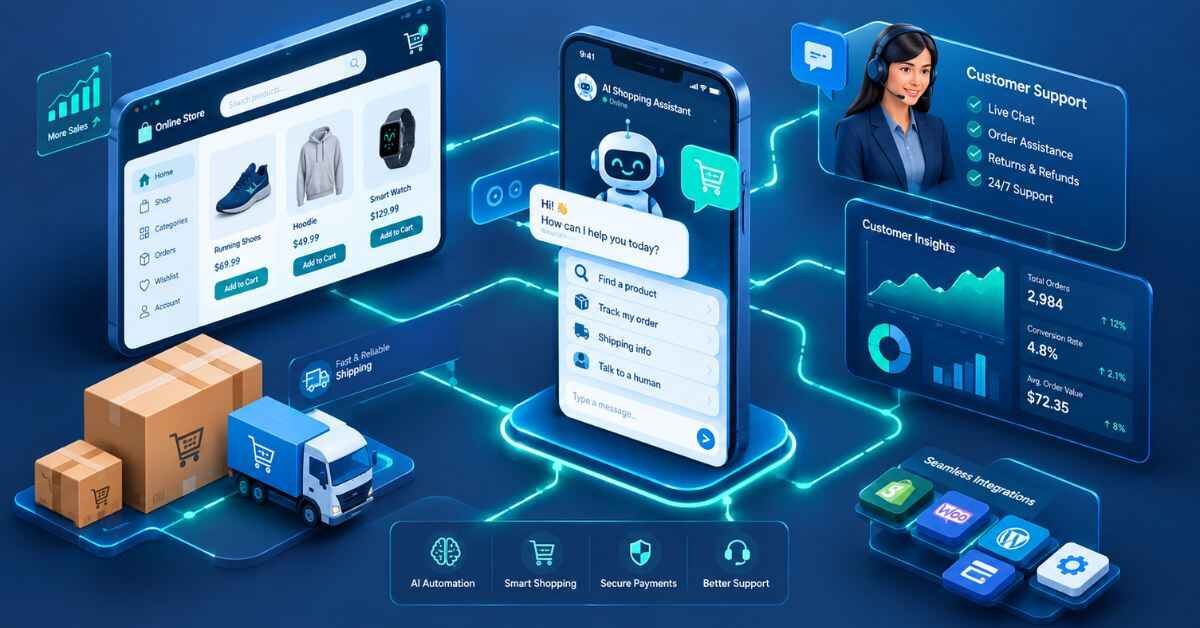
Picture this: a shopper lands on your online store at 11 PM with a quick question about sizing, but there is no one available to help. Within minutes, they close the tab, and that sale disappears forever. Managing customer queries around the clock is exhausting, and missing out on eager buyers because of slow response times feels deeply frustrating.
That is exactly where a smart ecommerce chatbot comes in to transform your daily store operations. In this guide, we will break down how these conversational tools work, how to pick the right platform for your tech stack, and how to turn casual late-night site visitors into loyal customers.
E-commerce chatbots, defined
An e-commerce chatbot is an automated software application designed to converse with users and manage routine retail tasks in online store environments. It serves as a direct conversational interface, eliminating the need for shoppers to hunt through complex menus or wait on hold for a support agent.
These digital assistants handle immediate customer queries by answering FAQs, providing real-time support, suggesting relevant items, and giving live order status updates without human help. Typically embedded on websites, messaging apps like WhatsApp or Facebook Messenger, and platforms like Shopify through APIs, chatbots are widely used, with 85% of retail businesses having already adopted them.
What Is an AI chatbot for ecommerce?
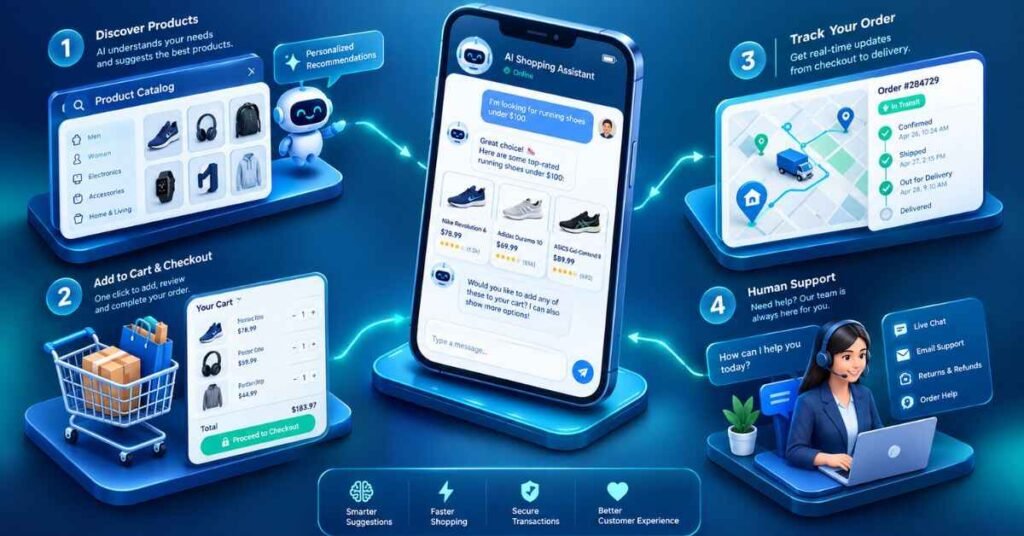
An AI chatbot for e-commerce goes beyond static scripts by using Machine Learning (ML) and Natural Language Processing (NLP) to understand visitor intent. Instead of getting stuck on rigid phrasing, it interprets context, processes open-ended questions, and learns from user interactions over time.
Trained on your store’s product catalog, support documentation, and FAQs, an AI chatbot actively guides buyers during their purchasing journey. It helps shoppers make buying decisions, assists with post-sale requests, and smoothly hands off complex cases to human agents while keeping full context intact.
Chatbots vs AI agents: What’s the difference?
Chatbots and AI agents are closely related, but they differ significantly in their operational autonomy. Traditional chatbots are primary communication interfaces meant to collect user info, answer questions, and respond directly to prompts using predefined databases or LLMs.
AI agents, on the other hand, operate autonomously to carry out multi-step tasks beyond basic prompt-response exchanges. While a chatbot simply tells a customer an item is out of stock, an AI agent can detect low inventory, autonomously contact suppliers to restock, and dynamically adjust pricing strategy.
Types of e-commerce chatbots
E-commerce chatbots fall into several primary categories depending on their technical architecture and primary function. Stores can select options ranging from basic click-menu bots to advanced generative AI systems:
- Rule-based chatbots: Rely on simple decision trees and “if/then” logic where users click structured menu options.
- AI-powered chatbots: Utilize NLP, ML, and LLMs to understand open-ended queries, interpret user intent, and deliver personalized responses.
- Messaging-focused chatbots: Tailored specifically for external social apps like WhatsApp, Facebook Messenger, and Telegram.
- Transactional chatbots: Focus on completing actions like processing checkouts, tracking orders, or handling returns by connecting to CRMs and inventory databases.
- Hybrid chatbots: Combine rule-based buttons with AI understanding, offering instant quick-reply menus alongside an option to talk to live agents.
Two Types of Ecommerce Chatbots (And Why the Distinction Matters)
Choosing between rule-based and AI-powered bots is a fundamental decision that impacts both customer experience and operational overhead. Rule-based bots are easy to deploy and work well for simple FAQs or order tracking, but they break down when faced with complex phrasing or open-ended inquiries.
AI-powered bots require more initial data grounding, but they adapt seamlessly to typos, varied context, and conversational nuances. Understanding this distinction prevents online stores from deploying rigid bots that frustrate shoppers when natural conversations are needed.
Benefits of e-commerce chatbots
Implementing a chatbot brings major operational advantages to fast-growing online retail businesses. They help streamline store management while delivering consistent customer service:
- 24/7 Availability: Provides round-the-clock coverage for shoppers in any time zone without adding night-shift support staff.
- Scalability: Handles thousands of customer conversations at the same time during traffic spikes without dropping response quality.
- Cost Efficiency: Reduces overall support overhead by deflecting repetitive high-volume queries away from human agents.
- Data-Driven Insights: Captures aggregated chat interaction data to highlight common customer friction points and product demand trends.
Benefits of using chatbots for ecommerce
From a revenue perspective, e-commerce chatbots actively drive store profitability by optimizing the conversion funnel. They engage site visitors at critical points in their shopping journey to recover lost sales.
By proactively reaching out to shoppers who pause at checkout or abandon their carts, bots can offer timely discounts or clear up last-minute doubts. Instant responses also eliminate buying friction, making shoppers far more likely to complete their purchases immediately.
Use cases for e-commerce chatbots
Chatbots assist shoppers across every single stage of the post-discovery customer journey. They handle diverse tasks that make running an online store smoother:
- Answering FAQs: Instantly resolves queries regarding shipping costs, return windows, and store policies.
- Recovering Abandoned Carts: Triggers proactive follow-ups on web, SMS, or messaging channels to bring shoppers back.
- Product Recommendations: Suggests items based on user preferences, aiding product discovery and facilitating upselling.
- Order Tracking: Fetches real-time shipping updates directly from order management systems.
- Lead Qualification: Collects customer preferences and routes high-intent B2B or wholesale inquiries to sales reps.
How to use an ecommerce chatbot
To make the most of your chatbot, you should deploy it strategically across key conversion touchpoints. Place the chat widget on high-intent pages such as product listings, cart pages, and checkout views where shoppers often have last-minute questions.
You can also set behavioral triggers, such as initiating a chat window when a user spends extended time on a page or moves their mouse to leave. Connecting the bot to your messaging channels like WhatsApp and Instagram DMs ensures a seamless omnichannel presence.
Key features of an effective ecommerce chatbot
Not all chatbots deliver equal results, and specific capabilities separate revenue generators from annoying pop-ups. Ensure your platform includes these essential features:
| Feature Category | Key Capability | Business Impact |
| Data Grounding | KB and product catalog sync | Eliminates AI hallucinations and ensures accurate responses |
| System Integration | Shopify, CRM, and Helpdesk APIs | Enables direct order updates and customer data syncing |
| Analytics & Sentiment | Intent & frustration flagging | Warns support teams before customers churn |
| Live Agent Handoff | Seamless context-rich transfer | Ensures complex cases get human help without forcing users to repeat themselves |
What To Look for in an Ecommerce Chatbot
When selecting a chatbot solution, focus on platforms that offer simple visual workflow builders alongside robust natural language processing. Look for tools that ground their answers directly in your provided content with source citations to keep responses accurate.
Security, data privacy compliance, and multi-language support are also critical if you serve international buyers. Finally, review the pricing model carefully to make sure costs do not spike unexpectedly as chat volumes scale.
Challenges and limitations of e-commerce chatbots
Despite their advantages, chatbots come with clear technical and operational limitations. Outdated product catalogs or inaccurate policy files cause the bot to deliver wrong answers, damaging buyer trust.
Additionally, chatbots struggle with deep emotional nuances, making them ill-suited for angry customers demanding refunds or dispute resolutions. Technical setup complexity can also lead to broken integrations, and many consumers still prefer human agents when dealing with delicate issues.
Top 10 eCommerce Chatbots to Boost Sales and Conversions
Choosing the right software depends heavily on your primary tech stack, budget, and business model. Here is a breakdown of top-rated platforms across various use cases:
- ProProfs Chat: Best for easy 24/7 automated support, featuring website URL training, sentiment analysis, and risk prediction.
- Chatfuel: Tailored specifically for social commerce on Facebook, Instagram, and Telegram with no-code keyword rules.
- Intercom (Fin): Designed for mid-market stores handling multi-turn support workflows and complex help center data.
- Pandorabots: Ideal for developer teams needing deep NLP customization using AIML scripting.
- Engati: Offers a unified “OneView Inbox” consolidating website, WhatsApp, and social channels in one place.
- Botsify: Excellent for conversational lead generation forms and conditional branching logic.
- Tidio (Lyro): Highly popular for Shopify and WooCommerce stores needing pre-built cart recovery flows.
- Drift: Focused on high-value B2B e-commerce, pipeline generation, and account-based engagement.
- ManyChat: Specializes in DM automation for Instagram, Facebook, and SMS marketing campaigns.
- GetMyAI: Delivers fast AI-driven answers for product-heavy websites.
The Best AI Chatbots for Ecommerce
The best AI chatbots rely on advanced LLM architectures to hold fluid, natural conversations. Solutions like Intercom’s Fin, ProProfs’ AI agent, and Tidio’s Lyro stand out because they ground their knowledge directly in store documentation.
Rather than relying purely on pre-scripted buttons, these systems process complex, multi-part customer questions. They offer personalized advice, check real-time stock levels, and resolve support requests autonomously.
7 best ecommerce chatbots to boost your business in 2026
As conversational commerce evolves, top platforms in 2026 place heavy emphasis on omnichannel messaging, generative AI accuracy, and self-service capabilities. Solutions like ProProfs Chat, Tidio, Chatfuel, Intercom, Engati, Drift, and Botsify lead the market by making bot management accessible to non-technical teams.
These tools let store owners deploy sophisticated automated workflows without writing custom code. They bridge the gap between simple website widgets and enterprise-grade automation.
My Top 3 Picks for eCommerce Chatbots
- ProProfs Chat: Best overall for rapid deployment, ease of use, deep knowledge base grounding, and comprehensive support suite integration.
- Tidio: Best for small to medium-sized Shopify or WooCommerce stores looking for plug-and-play e-commerce templates.
- Intercom: Best for enterprise and mid-market brands requiring complex multi-step workflow automation and CRM depth.
How I Evaluated These eCommerce Chatbot Tools
Evaluating chatbot tools requires looking past marketing claims to test real-world functionality under pressure. Assessment relies on hands-on testing, verified user reviews across industry sites like G2 and Capterra, and key performance criteria.
Critical rating factors include setup speed, accuracy of AI responses, quality of platform integrations, multi-channel flexibility, analytics depth, and scalability relative to pricing.
How To Choose the Right Ecommerce Chatbot for Your Business
Selecting the ideal software starts with evaluating your current store stack, support ticket volume, and primary sales channels. If most sales originate from social platforms, prioritize tools with native Instagram and WhatsApp integrations.
If your team struggles with high-volume repetitive queries, look for platforms with high ticket-deflection capabilities and simple KB import features. Always run a 30-day pilot to track core success metrics like resolution rates and CSAT before committing long term.
How to integrate chatbots into e-commerce operations
Successfully rolling out a chatbot requires a structured operational sequence to prevent implementation errors:
- Define Core Objectives: Clearly outline whether the primary goal is ticket deflection, cart recovery, or lead capture.
- Align Platform with Scale: Pick a plug-and-play plugin for small stores or an enterprise solution for complex tech stacks.
- Map Conversation Flows: Plan primary paths for top customer queries and define explicit rules for live agent handoffs.
- Build the Knowledge Base: Clean and structure your policy pages, product details, and FAQs so the AI has accurate data.
- Test and Optimize: Run real-world edge cases to test error handling before monitoring performance post-launch.
How to make an AI chatbot for ecommerce
Creating an AI chatbot no longer requires a team of developers. Modern platforms allow non-technical store owners to build and deploy a functional AI agent within hours:
- Point the chatbot platform at your store URL or upload help center files to ground the AI.
- Configure custom colors, launcher styles, and branding to match your site design.
- Set up conditional branching logic and automated actions like Shopify order updates.
- Integrate your primary communication channels and test query fallbacks.
Real-world ecommerce chatbot results
Stores that implement grounded AI chatbots see measurable improvements in operational efficiency and sales performance. Businesses frequently report 24/7 support coverage without increasing support staff headcount.
Industry estimates project that automated customer service tools will handle up to 80% of routine issues, reducing overall customer support costs significantly. Fast response times also directly lower bounce rates and improve overall conversion rates.
Expert opinion
E-commerce specialists emphasize that chatbots should complement human support teams, not replace them entirely. The most successful implementations treat the bot as a first line of defense that resolves routine queries quickly.
When complex or emotionally sensitive issues arise, the bot must seamlessly escalate the conversation to a human support agent. Preserving conversation context during this handoff is crucial for maintaining a positive customer experience.
The latest AI trends, brought to you by experts
The rapid advancement of generative AI and LLMs is reshaping how brands approach conversational commerce. Modern chatbots have moved far beyond rigid decision trees to interpret complex context and generate natural, human-like answers.
Emerging tools allow businesses to build scalable assistants grounded strictly in verified enterprise data. This ensures that automated interactions stay accurate, secure, and aligned with company brand guidelines.
Turn customer conversations into sales
Conversational commerce turns everyday support interactions into revenue-generating sales opportunities. When a shopper asks a support question, the bot can suggest relevant products, share discount codes, or upsell accessories.
Removing hesitation during the buying process creates a fast, personalized experience similar to speaking with an in-store sales assistant.
Take Conversational Commerce Further With Bloomreach
For enterprise brands, advanced conversational platforms like Bloomreach elevate the shopping experience by combining customer data with AI recommendations. These platforms connect behavioral data, inventory records, and chat history to deliver deeply personalized interactions.
By delivering targeted product suggestions and automated support messaging across web and mobile channels, enterprise solutions help large online stores maximize customer lifetime value.
Frequently asked questions about ecommerce chatbots
Can an e-commerce chatbot integrate with my existing tech stack?
Yes, most modern chatbot platforms offer direct integrations, APIs, and webhooks to connect with Shopify, WooCommerce, platforms like Salesforce or HubSpot, and help desk systems.
What happens when the chatbot cannot answer a question?
A well-designed bot uses conditional fallback rules to smoothly transfer the customer to a live human agent while sharing the existing chat history.
Are chatbots difficult to set up and train?
No, no-code platforms allow you to train an AI chatbot quickly by linking your store URL or uploading existing FAQ documents.

Muhammad Talha breaks down complex AI tools into simple, step-by-step guides for e-commerce entrepreneurs. His goal: to help you work smarter, not harder, by leveraging artificial intelligence