

Running an online store used to mean juggling a dozen manual tasks at once — writing product descriptions late at night, answering the same three customer questions over and over, and guessing at prices based on gut feeling. That era is fading fast. AI tools for ecommerce now handle most of that heavy lifting, and the stores that adopt them early are pulling ahead of the ones still doing everything by hand.
This guide breaks down what these tools actually do, which ones are genuinely worth your time in 2026, and how to build a stack that fits your store instead of copying whatever a bigger brand is using. We’ll also walk through common mistakes so you don’t waste months figuring them out the hard way.
What Are AI Tools for Ecommerce (and Why They Matter in 2026)
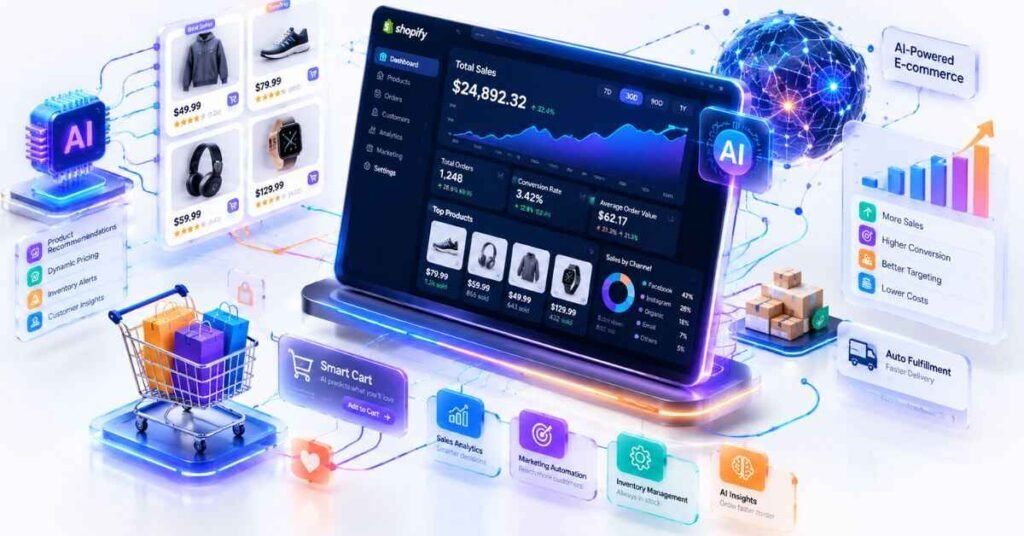
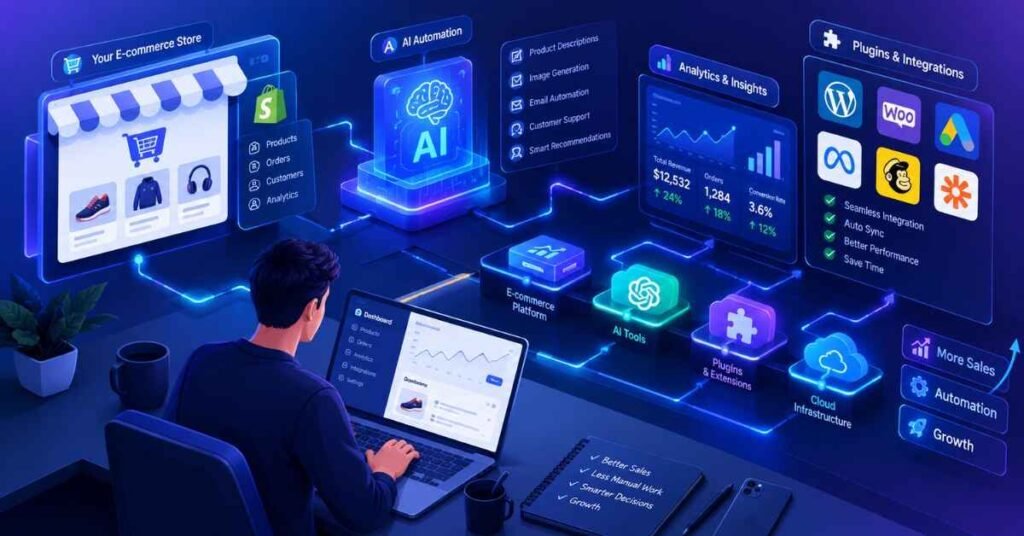
AI tools for ecommerce are software solutions that use machine learning and generative AI to automate tasks across your online store — from writing content to predicting what a customer will buy next. They plug into your existing platform, whether that’s Shopify, WooCommerce, or a custom-built storefront, and take over work that used to require a full team of writers, support agents, and analysts.
The shift matters because shopper expectations have moved faster than most stores can keep up with manually. People want instant answers, product suggestions that actually feel relevant, and a checkout that doesn’t make them think twice. A store still running on spreadsheets and manual replies can’t compete with one using AI chatbots for round-the-clock support, dynamic pricing that adjusts automatically, and generative AI producing content at a scale no single person could match. If you’re not using at least one of these tools yet, you’re likely already losing ground to competitors who are.
Why AI Is Essential for Ecommerce
It’s worth pausing here to explain why this isn’t just another passing trend. Ecommerce runs on speed and volume — thousands of product listings, constant customer questions, and pricing that needs to react to the market in real time. Humans simply can’t do all of that at the pace modern shoppers expect, and trying to hire your way out of the problem gets expensive fast.
Key Benefits of AI for Ecommerce:
- Faster content production — product descriptions and ad copy generated in minutes instead of days
- 24/7 customer support — chatbots that answer order status and FAQ questions instantly, any time zone
- Smarter pricing — dynamic pricing tools that track competitors and adjust automatically
- Personalization at scale — product recommendations tailored to each visitor’s browsing behavior
- Reduced operational costs — fewer manual hours spent on repetitive tasks
Getting Started With AI for Ecommerce
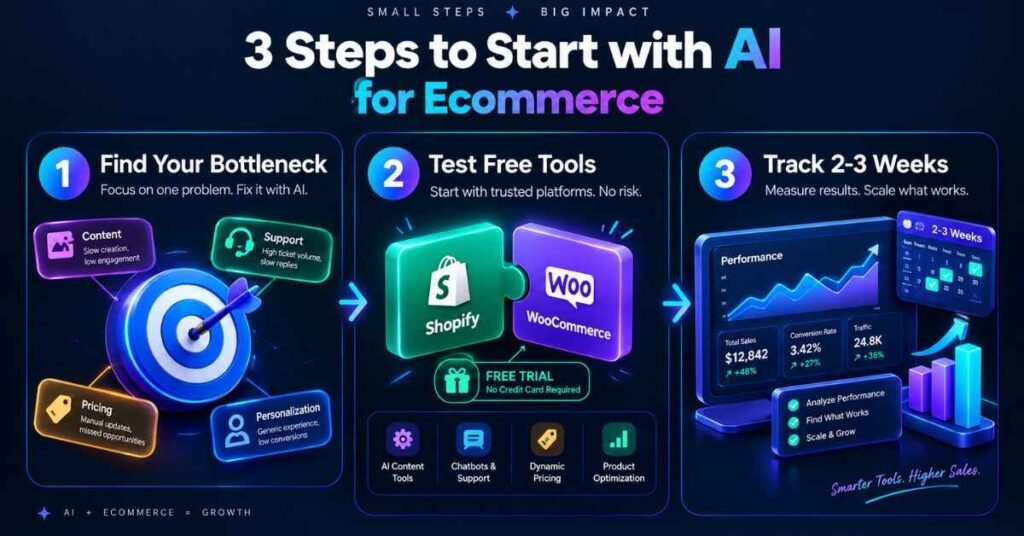
If you’re new to this, the temptation is to install five tools at once and hope something sticks. Resist that. The better approach is to identify your single biggest bottleneck first — content, support, pricing, or personalization — and solve that one problem before adding anything else.
Once you’ve picked your starting point, look for a tool with a free trial or free tier so you can test it against your actual store data before committing. Most platforms integrate directly with Shopify or WooCommerce through a plugin, so setup usually takes less than an hour. Track your results for two to three weeks before deciding whether to keep the tool, upgrade it, or replace it with something else.
TL;DR — The Best AI Ecommerce Tools at a Glance
If you’re short on time, here’s the quick version. Each of these tools solves a different problem, so most stores end up using two or three together rather than relying on just one.
- Shopify Magic — Best for stores already on Shopify wanting built-in AI content tools
- Tidio AI — Best for AI chatbots and customer support automation
- Jasper.ai — Best for scaling product descriptions and ad copy
- Nosto — Best for personalized product recommendations
- Prisync — Best for dynamic pricing and competitor tracking
- DataFeedWatch — Best for optimizing product feeds across marketplaces
- Zoovu — Best for AI-guided product discovery
Comparison Table: Best AI Tools for Ecommerce
| Tool | Best For | Starting Price |
| Shopify Magic | Built-in AI content | Free with Shopify plan |
| Tidio AI | Chatbots & support | Free tier available |
| Jasper.ai | Content at scale | Paid, from ~$39/mo |
| Nosto | Personalization | Custom pricing |
| Prisync | Dynamic pricing | Paid, from ~$29/mo |
| DataFeedWatch | Product feed optimization | Paid, from ~$49/mo |
AI Tools for Ecommerce: Category-by-Category Breakdown
Not every AI tool does the same job, so it helps to think in categories instead of a single ranked list. Most successful stores build a stack that covers content, customer experience, and operations rather than betting everything on one platform doing it all.
For content, tools like Jasper.ai and Shopify Magic act as an AI content assistant, generating product descriptions, email copy, and ad creative at a pace no human writer can match alone. For customer experience, AI chatbots such as Tidio and HubSpot’s chatbot builder handle order status questions and basic support around the clock, freeing your team to focus on the complex issues that actually need a human touch. For operations, tools like Prisync and DataFeedWatch quietly manage dynamic pricing and product feed optimization in the background, keeping your margins and marketplace listings accurate without daily manual checks.
Comprehensive Review of AI Tools and Solutions
1. DataFeedWatch — Best for Optimized Product Feeds
DataFeedWatch cleans up and optimizes your product catalog for Google Shopping, Meta, and other marketplaces. It automatically fixes formatting errors and missing attributes that would otherwise get your listings rejected, which directly affects organic search visibility.
2. Zoovu — Best for Product Recommendations
Zoovu uses conversational AI to guide shoppers toward the right product through a series of simple questions, similar to how an in-store salesperson would. It works especially well for stores with complex catalogs where customers often aren’t sure exactly what they need.
3. HubSpot Chatbot Builder — Best for Building AI Chatbots
HubSpot’s chatbot builder lets you design custom conversation flows without writing code, and it connects directly to your CRM so every conversation feeds into your customer data. It’s a strong pick if you’re already using HubSpot for marketing.
4. Prisync — Best for Dynamic Pricing
Prisync tracks competitor prices automatically across multiple marketplaces and suggests adjustments in real time. This removes the need to manually check rival stores every week, which adds up to real hours saved over a month.
5. Nosto — Best for AI Product Recommendations & Personalization
Nosto uses machine learning to show each visitor different product recommendations based on their individual browsing behavior. Stores using it consistently report a meaningful lift in conversion rate optimization metrics compared to static recommendation widgets.
How We Tested the Best AI Ecommerce Website Builders
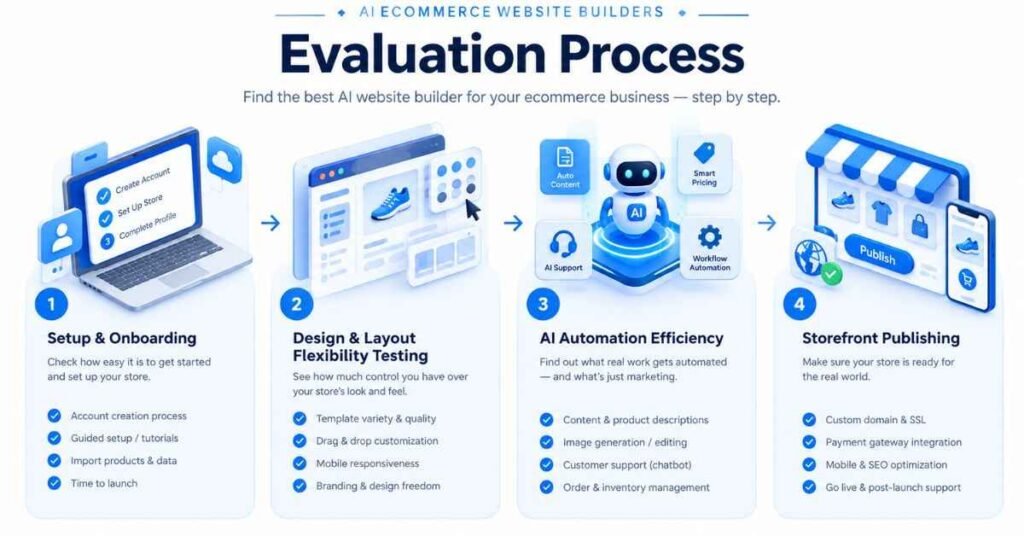
Beyond individual tools, a growing number of stores are choosing AI website builders that bake automation directly into the storefront itself. We evaluated these based on ease of setup, design flexibility, and how well the AI features actually reduced manual work rather than just adding a gimmick.
The Best AI Website Builders for Ecommerce in 2026 at a Glance
- Shopify — Best for serious, scaling ecommerce businesses
- Framer — Best for design-savvy founders who want full visual control
- Wix AI — Best for beginners wanting a guided setup
- Hostinger AI — Best budget option for small catalog stores
- 10Web — Best for WordPress-based stores wanting AI automation
4. Shopify — Best for Serious Ecommerce
Shopify remains the most complete option for stores planning to scale, with AI features like Shopify Magic built directly into the dashboard alongside a massive app ecosystem. It handles everything from checkout to inventory without needing third-party workarounds for the basics.
5. Framer — Best for Design-Savvy Founders
Framer gives founders drag-and-drop design control with AI-assisted page generation, making it a favorite for single-product DTC brands that care deeply about visual hierarchy and brand translation. It’s less suited to large multi-page catalog stores, though.
Integrating AI Tools Across Operations
Once you’ve picked individual tools, the real value comes from connecting them so they share data instead of operating in silos. A chatbot that doesn’t know your current inventory levels, for example, will keep promising products that are actually out of stock.
Most modern AI tools for ecommerce support API integration or webhooks, allowing your content, pricing, and support systems to stay in sync automatically. Setting this up properly early on saves you from a messy migration later, when you’re managing five disconnected tools and none of them talk to each other.
How to Implement AI for Ecommerce
Implementation goes smoothly when you treat it as a phased rollout instead of an overnight switch. Start with one tool in one part of your store, measure the impact over a few weeks, and only then move to the next area.
Document what “success” looks like before you start — whether that’s faster response times, higher conversion rate, or fewer support tickets. Without a clear baseline, it’s nearly impossible to know whether the tool is actually helping or just adding noise to your existing workflow.
How to Choose the Right AI Tools for Your Ecommerce Stack
With so many options on the market, picking the right tool comes down to knowing exactly where your store is losing time or revenue. A store bleeding customers at checkout needs a very different tool than one struggling to keep up with content production.
Start by listing your biggest bottleneck first. From there, check pricing transparency and avoid tools that hide costs behind a “contact us” button unless you’re operating at enterprise scale. Confirm the tool integrates with your existing CMS or ecommerce tools without requiring custom code, since that’s often where smaller teams get stuck for weeks.
Decision Checklist: Choosing the Best AI Tools
- Does it solve your single biggest bottleneck right now?
- Is pricing transparent and predictable as you scale?
- Does it integrate with your current platform without custom development?
- Is there a free trial or free tier to test before committing?
- Does the vendor offer real support, not just a chatbot for their own product?
Common Mistakes When Adopting AI Tools for Ecommerce
Even good tools fail when they’re implemented poorly. The most common mistake is stacking too many tools at once, which creates overlapping features, confused teams, and wasted spend instead of a clean workflow.
Another frequent issue is skipping the testing phase entirely. Stores that plug in a new AI chatbot or pricing tool without A/B testing the results often can’t tell whether it’s actually helping or quietly hurting conversions. Treat every new tool like an experiment: measure it against your baseline before committing to a long-term contract.
Building an AI-Ready Ecommerce Future
The stores that will still be competitive in a few years aren’t the ones chasing every new AI tool that launches. They’re the ones that built a deliberate, well-integrated stack around their actual bottlenecks and kept refining it as their business grew.
Start small, measure everything, and resist the urge to add a tool just because a competitor mentioned it. The goal isn’t to use the most AI tools for ecommerce — it’s to use the right ones for the problems your store actually has.
Conclusion
Choosing the right AI tools for ecommerce isn’t about picking the flashiest name on a list — it’s about matching a tool to the exact bottleneck slowing your store down, whether that’s content, support, pricing, or personalization. Start with one problem, test one tool properly, and only expand your stack once you can see real numbers behind the decision.
The stores winning in 2026 aren’t the ones running every AI tool on the market. They’re the ones who built a lean, well-integrated setup around what their business actually needs, and kept refining it as they grew. Do that, and you’ll spend less time managing tools and more time actually running your store.
FAQ
What are the best free AI tools for ecommerce?
Shopify Magic and Tidio both offer free tiers covering basic content and chatbot needs, making them a solid starting point before upgrading to a paid plan.
Do AI tools for ecommerce work with WooCommerce?
Most do, though integration depends on the specific tool. Check for a dedicated WooCommerce plugin or documented API support before committing.
Is dynamic pricing worth it for small stores?
Yes — even small catalogs benefit from automated competitor tracking, since manual price checks eat up hours that are better spent elsewhere.
How many AI tools should a small store use at once?
Start with one or two that address your biggest bottleneck. Adding more than that before you’ve measured results usually creates confusion rather than value.
Can AI tools replace a customer support team entirely?
Not entirely. They handle repetitive questions well, but complex or sensitive issues still need a human, so most stores use AI to filter and reduce ticket volume rather than eliminate support staff.

Muhammad Talha breaks down complex AI tools into simple, step-by-step guides for e-commerce entrepreneurs. His goal: to help you work smarter, not harder, by leveraging artificial intelligence