

You’ve invested in AI to generate product descriptions, blog posts, and personalized emails. But is that content actually driving revenue, or is it just another cost on your spreadsheet?
For e-commerce leaders, measuring the true ROI of AI-generated content isn’t a luxury—it’s the difference between a strategic advantage and a costly experiment. This guide breaks down a clear, actionable framework to move beyond vanity metrics and prove the financial impact of your AI content.
Why This Matters: The AI Content Mandate
- Projected AI Market Size by 2033: Nearly $51 Billion
- Current AI Adoption in E-commerce: 51%
- Sales Uplift from AI Recommendations: Up to 59%
- Reduction in Time to Purchase: 47%
The businesses that win won’t be the ones using AI; they’ll be the ones measuring its performance and optimizing relentlessly.
1. Understanding ROI: Trending vs. Realized
Before diving into metrics, you must understand the two types of ROI you’ll encounter.
What is ROI in AI Content?
It’s the process of quantifying the value generated from AI-created digital assets against the costs of tools, labor, and implementation. The benefits extend beyond direct sales to include cost savings, operational efficiency, and enhanced customer loyalty.
The Two Phases of ROI:
| Type of ROI | What It Measures | Timeframe | Why It’s Important |
|---|---|---|---|
| Trending ROI | Early signals like productivity gains, increased traffic, and higher engagement. | Short-term (Days to Weeks) | Validates your initial strategy and provides early confidence that you’re on the right track. |
| Realized ROI | Concrete business outcomes like cost reduction, revenue growth, and profit increase. | Long-term (Quarters to Years) | Proves the definitive financial impact and justifies continued or expanded investment. |
Pro Tip: Don’t wait for realized ROI to report success. Showcasing trending ROI (e.g., “We’ve cut content production time by 40%”) builds internal buy-in while you wait for long-term sales data.
Case Study: AI Content in Action
That lines up with what Peter Rota shared on LinkedIn. He used AI to publish five blog posts per month, each supported by five quality backlinks. The content made up about 21% of the site’s total indexed pages and grew steadily through four core updates and three spam updates.
“I’m a proponent of publishing AI content at a steady pace. If you just start blasting a site with AI content that adds no new value, you’re more likely to take some hits.”
– Peter Rota
Tip: Consistency + quality backlinks = sustainable growth with AI content.
2. The Essential Metrics Framework: What to Track and Why
To build a complete picture, track metrics across three categories: Performance, Conversion, and Business Impact.
A. Performance Metrics (The Top-of-Funnel Indicators)
These metrics tell you if your AI content is effective at attracting and engaging your audience.
- Organic Traffic: Are more people finding your AI-generated pages?
- Search Engine Rankings: Where do your AI-optimized pages rank for target keywords?
- User Engagement: Time on page, bounce rate, and pages per session.
The Reality Check: A recent study found that 67% of early adopters saw a traffic increase within six months. However, there is no direct proven link between AI content and rankings—quality and relevance remain the supreme ranking factors. Google rewards helpful content, regardless of its origin.
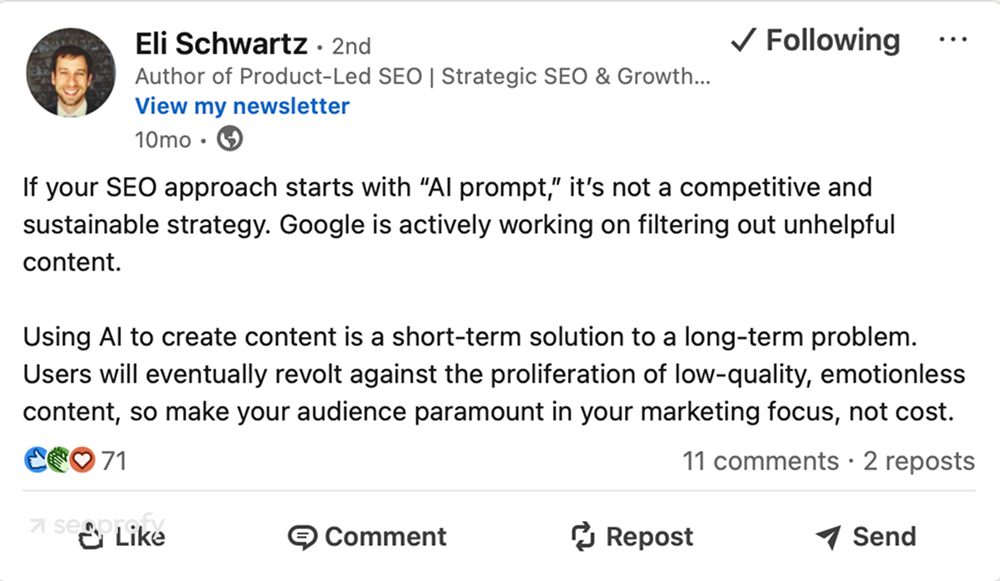
Note: SEO experts like Eli Schwartz are careful about using AI content for a long time. Quality and relevance should always come first.
B. Conversion & Efficiency Metrics (The Bottom-Line Drivers)
This is where you connect content to commerce. These metrics reveal how effectively AI content turns visitors into customers and saves you money.
| Metric | Why It Matters |
|---|---|
| Conversion Rate | The ultimate test: Does the content persuade visitors to buy? AI personalization can boost rates by up to 30%. |
| Customer Acquisition Cost (CAC) | How much does it cost to acquire a new customer? Effective AI content lowers this by converting more visitors from the same ad spend. |
| Return on Ad Spend (ROAS) | AI-optimized product descriptions and landing pages can make your paid ads more relevant, potentially increasing ROAS by 17% or more. |
C. Business Impact Metrics (The Long-Game Champions)
These metrics demonstrate the strategic, long-term value of your AI investment.
- Customer Lifetime Value (CLV): This is the superstar. AI-driven personalization and recommendations keep customers coming back. Companies that focus on CLV often see a 3x to 5x return on their marketing spend.
- Revenue Growth: Businesses using AI for personalization report an average revenue increase of 10-20%. For example, Amazon attributes 35% of its revenue to AI-powered product recommendations.
- Operational Efficiency: Measure the time and money saved by automating content creation for thousands of product pages, which frees your team for high-level strategy.
Expert Insight: Predicting ROI & Customer Behavior
“Always include failure scenarios in training data. Our models analyzing both 9:1 ROAS successes and 0.8:1 flops achieve 27% better prediction stability. Also, update customer decay rates monthly – attention spans shifted 19% faster in 2024 than 2020.”
– Dr. Elena Torres, Growth-onomics CMO

AI for Ecommerce: The Complete Guide to Systemizing Your Content Engine
Master AI for ecommerce and build a scalable content engine. This guide provides a proven framework to automate product descriptions and marketing copy.
3. The Toolkit: Attribution and Testing Models
You can’t manage what you can’t measure. These tools and models connect your AI content to your results.
AI Analytics Platforms
Choose a platform that integrates with your e-commerce stack and provides a unified view.
| Platform | Best For | Key Strength |
|---|---|---|
| Madgicx | Brands spending $10K+/month on Meta ads | AI-powered, profit-focused ad optimization. |
| Triple Whale | Multi-channel e-commerce brands | Centralized dashboard for tracking revenue, attribution, and profit. |
| Northbeam | DTC brands with complex customer journeys | Advanced machine learning for multi-touch attribution. |
Attribution Models: Connecting Content to Conversion
Forget “last-click” attribution. AI content often plays a role earlier in the journey. Multi-touch attribution models use algorithms to assign value to each touchpoint (e.g., a blog post, a product description, an email), giving you a realistic view of how your AI content influences sales.
A/B Testing: The Proof is in the Pudding
AI can generate hypotheses, but A/B testing provides the truth.
- Test Everything: Subject lines, product descriptions, landing page copy.
- Methodology: Use AI-powered A/B testing tools that leverage the “multi-armed bandit” method to automatically send more traffic to the winning variation, maximizing results faster.
4. The Calculation: A Step-by-Step Guide to ROI
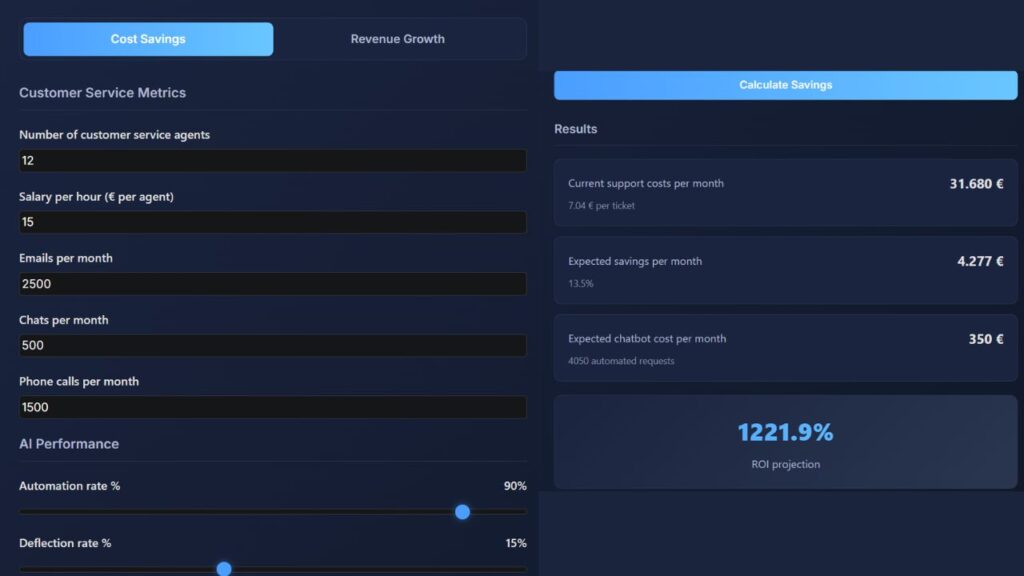
Let’s make the math simple and tangible.
Step 1: Data Collection & Integration
- Audit Your Data Sources: Connect your website analytics (Google Analytics), CRM (HubSpot/Salesforce), and ad platforms (Google Ads, Meta).
- Ensure Data Quality: Clean, consistent data is non-negotiable. Conduct regular audits to fix formatting errors and remove duplicates.
Step 2: The ROI Formula and a Real-World Example
The fundamental formula is:
ROI = (Net Gain from Investment / Cost of Investment) x 100
Where:
Net Gain = (Total Revenue Attributable to AI Content – Total Cost of AI Content)
Example: An E-commerce AI Content Project
An online home goods store uses an AI tool ($5,000/year) and a part-time editor ($2,000) to create and optimize 1,000 product descriptions.
- Total AI Content Cost: $7,000
- Tracked Results (over 6 months):
- Products with new AI descriptions see a 12% increase in conversion rate.
- This drives an additional $40,000 in attributable revenue.
Calculation:
- Net Gain = $40,000 (Revenue) – $7,000 (Cost) = $33,000
- ROI = ($33,000 / $7,000) x 100 = 471% ROI
Calculate ROI through our ROI calculator. This powerful number justifies the investment and funds the next project.
Step 3: Interpreting the Results
- Look Beyond Vanity Metrics: Page views are nice, but sales pay the bills.
- Track Micro-Conversions: Newsletter signups, review submissions, and add-to-carts are leading indicators of future sales and should be part of your success definition.
- Conduct Regular Reviews: Analyze your ROI quarterly. The market changes, and your measurement strategy should evolve with it.
5. Maximizing ROI and Overcoming Common Challenges
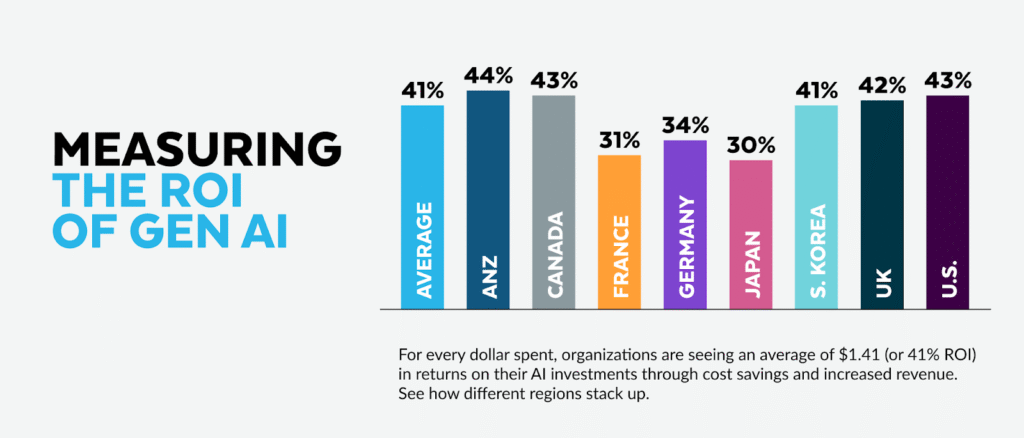
Best Practices for Success:
- Start with a Pilot: Test AI on a specific category or campaign before going all-in.
- Integrate with Your Tech Stack: Ensure your AI tools work seamlessly with your e-commerce platform, CMS, and CRM.
- Invest in Training: Empower your team to use AI tools effectively, shifting their focus from creation to curation and strategy.
- Focus on the Customer: Use AI for hyper-personalization. Smart recommendation engines can increase revenue from existing customers by up to 300%.
Troubleshooting Measurement Issues:
- Problem: “Our data is siloed and messy.”
- Solution: Start with a data audit and invest in a Customer Data Platform (CDP) to create a single source of truth.
- Problem: “We’re only tracking last-click conversions.”
- Solution: Implement a multi-touch attribution model to understand the full customer journey.
- Problem: “We don’t know the true cost.”
- Solution: Perform a Total Cost of Ownership (TCO) analysis that includes software, labor, training, and integration costs.
Conclusion: Measure, Optimize, Dominate
Measuring the ROI of AI content is not a one-time project—it’s a continuous cycle of measurement, learning, and optimization. By defining the right metrics, leveraging the right tools, and calculating true financial impact, you can move from guessing to knowing.
The future of e-commerce belongs to brands that use data not just to sell, but to learn, adapt, and create unparalleled customer experiences. Your AI content is a goldmine of insight and opportunity. It’s time to start measuring its real value.
FAQs: Measuring the ROI of AI Content in E-Commerce
Q1: What’s the biggest mistake brands make when measuring AI content ROI?
The most common mistake is relying on “vanity metrics” like page views or social shares without connecting them to business outcomes. Another major pitfall is failing to account for the total cost of ownership, including editing time, software subscriptions, and integration efforts. True ROI is only visible when you link content performance directly to revenue, cost savings, and customer lifetime value.
Q2: How long does it typically take to see a positive ROI from AI content?
It depends on the content type and your goals:
- Trending ROI (Early Signals): You can see this in days or weeks. Examples include faster content production, increased organic traffic, or improved engagement rates.
- Realized ROI (Financial Impact): This usually takes 3 to 6 months to materialize as you gather enough data on conversion rate lifts, reduced customer acquisition costs, and increased sales. For long-term metrics like Customer Lifetime Value (CLV), it may take a year or more to see the full impact.
Q3: Can I measure AI content ROI with free tools like Google Analytics?
Yes, you can start with Google Analytics 4 (GA4). It’s powerful for tracking traffic, engagement, and conversions. However, for a complete picture—especially connecting ad spend across multiple channels to final revenue—dedicated e-commerce analytics platforms (like Triple Whale or Northbeam) are more robust. They simplify multi-touch attribution and provide a unified view of profitability that GA4 alone cannot.
Q4: My AI-generated content is ranking well but not converting. What’s wrong?
This is a classic sign of a quality or relevance issue. The AI content might be optimized for search engines but not for human buyers. It could lack:
- Specificity and Unique Value Propositions: It reads generically and doesn’t explain why your product is the best choice.
- Emotional Connection: It fails to address the user’s pain points or aspirations.
- Strong Calls-to-Action (CTAs): It doesn’t clearly guide the user to the next step.
Solution: Use A/B testing to experiment with different versions. Inject more human editing to add brand voice, practical use cases, and social proof.
Q5: How do I attribute a sale to a specific piece of AI content?
This is where attribution models are critical. A sale is rarely due to one single touchpoint.
- A customer might read an AI-generated blog post (first touch), later click on a retargeting ad featuring AI-written copy (middle touch), and finally purchase after reading the AI-optimized product description (last touch).
- Using a multi-touch attribution model in your analytics platform assigns fractional credit to each of these AI-driven interactions, giving you a much more accurate picture of how your content collectively influences sales.
Q6: How often should we review and adjust our AI content strategy based on ROI data?
You should be continuously monitoring key metrics. However, schedule formal quarterly business reviews (QBRs) to deeply analyze the ROI data, assess what’s working and what’s not, and make strategic pivots. The market and algorithms change fast; a quarterly review cycle ensures your AI content strategy remains agile and effective.
Q7: Does Google penalize websites for using AI-generated content?
No, not inherently. Google’s official stance is that it rewards “helpful, reliable, and people-first content,” regardless of how it was created. They do penalize content that is spammy, low-quality, or designed primarily to manipulate search rankings—a category that can include poorly executed AI content. The key is quality and value, not the tool used to create it. Always ensure your AI output is fact-checked, well-edited, and genuinely useful to a reader.

Muhammad Talha breaks down complex AI tools into simple, step-by-step guides for e-commerce entrepreneurs. His goal: to help you work smarter, not harder, by leveraging artificial intelligence