

Running an e-commerce store or managing a digital brand today requires a constant stream of visual assets. From high-converting product pages and promotional banners to social media creatives and mobile app interfaces, design quality directly impacts user trust and conversion rates. With artificial intelligence tools promising instant graphics at a fraction of the cost, store owners and marketing managers face a critical decision: Should you rely on AI generators, or do human designers remain essential for long-term growth?
The debate is often framed as a simple replacement issue, but real-world implementation tells a different story. While generative AI models have improved dramatically in rendering speed and visual quality, human intuition, strategic thinking, and emotional storytelling offer value that algorithms cannot duplicate. In this comprehensive comparison, we break down how AI and human designers stack up across workflows, financial investments, visual quality, user experience design, and overall brand consistency.
What “AI Design” Actually Covers Now
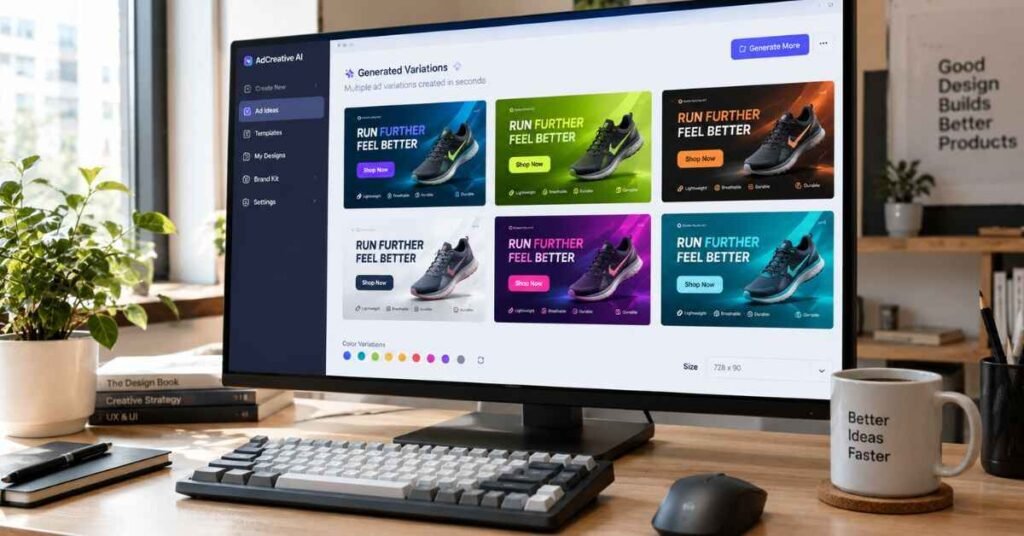
To evaluate AI fairly, it is important to understand that automated design software extends far beyond generating random stock art or applying basic image filters. Modern AI platforms are integrated into multiple stages of the visual pipeline, offering specialized capabilities across web design, graphic editing, and ad creation.
1. Generative Layouts and UI Components
Artificial intelligence platforms analyze thousands of high-performing websites to construct responsive wireframes, hero sections, and UI layouts based on user prompts. These systems help developers iterate quickly on early layout concepts without spending hours in design software.
2. Automated Image Editing and Retouching
E-commerce brands use AI algorithms to handle time-consuming asset processing. Automated tools can remove backgrounds, adjust lighting, add realistic product shadows, and correct color balances across hundreds of catalog photos in a single batch.
3. High-Volume Marketing Creatives
Social media and advertising campaigns demand continuous visual variations to prevent audience ad fatigue. AI generators build dozens of banner variations from a single master asset, resizing and reformatting graphics for Instagram, Facebook, and Google Ads seamlessly.
4. Dynamic Personalization at Scale
Enterprise platforms leverage AI to deliver tailored visuals to specific user segments. By analyzing visitor location, device, or past browsing behavior, AI dynamic engines swap background colors, promotional text, and hero imagery in real time.
Where AI Design Genuinely Wins
Artificial intelligence tools excel in scenarios that require high processing speed, repetitive data handling, and massive volume output. When used strategically, AI removes operational bottlenecks and lowers creation costs for growing businesses.
| Performance Metric | AI Design Tools | Human Designers |
| Turnaround Speed | Instant (Seconds to Minutes) | Measured (Hours to Days) |
| Production Scalability | Unlimited variant generation | Constrained by manual hours |
| Cost per Asset | Extremely low (Subscription model) | Professional hourly or project fees |
| Brand Consistency | Requires strict human supervision | Native understanding of brand identity |
| Strategic Problem-Solving | Limited (Pattern recombination) | High (Empathy and user research) |
Unmatched Speed and Rapid Prototyping
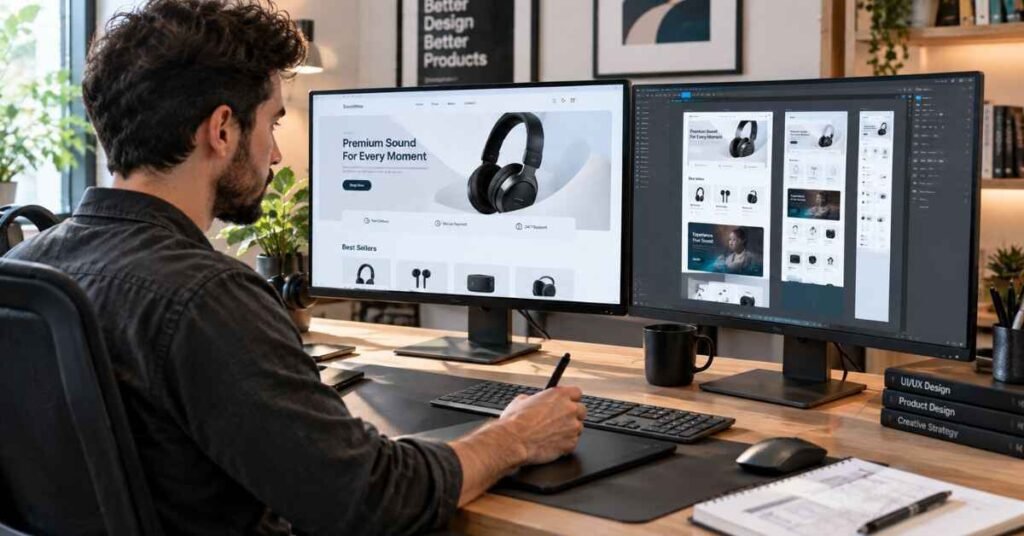
Traditional human design workflows involve research, mood boards, sketch iterations, and feedback loops. AI tools shorten the initial brainstorming phase by generating dozens of conceptual layouts in seconds, allowing project teams to test visual directions during client meetings.
High-Volume Graphic Scaling
E-commerce brands running performance marketing campaigns require fresh ad creatives continuously. AI generators allow team members to input a core product shot and receive variations in different aspect ratios, background textures, and typography placements immediately.
Cost Efficiency for Early-Stage Startups
For bootstrapped startups operating with minimal capital, hiring a full-time senior designer or creative agency is not always financially realistic. AI tool subscriptions offer an affordable stopgap solution for generating basic assets until revenue justifies professional hires.
Where Human Designers Win
While artificial intelligence can calculate visual trends and render images quickly, it lacks contextual awareness, cultural nuance, emotional resonance, and strategic vision.
Core Insight: Artificial intelligence creates visuals by recombining historical data patterns. Human designers build strategic design systems based on consumer psychology, brand positioning, and real-world empathy.
Strategic Brand Identity and Originality
A brand identity is far more than a clean logo or attractive layout. Human designers craft cohesive brand systems that express core company values, differentiate businesses from competitors, and appeal to target demographics. Raw AI generators struggle to create truly original concepts, often producing visuals that look derivative or generic.
User Experience (UX) Design and Empathy
Design is ultimately about solving functional problems for real people. Human designers conduct user testing, study friction points in checkout funnels, and organize layouts to guide users toward conversion naturally. AI cannot experience emotional frustration or understand complex user journeys firsthand.
Maintainable Design Systems and Scalability
Enterprise applications and multi-channel stores require structured design systems—clear component libraries, typography scales, accessibility guidelines, and interaction standards. Experienced human designers establish these frameworks to keep development and marketing teams aligned as the business expands.
The Rise of AI in Web Design
Web design has transformed from a purely manual coding process into a technology-assisted discipline. The integration of generative tools has altered how websites are planned, structured, and maintained.
From Rigid Templates to Generative Frameworks
In previous years, building a site meant modifying rigid pre-made templates or writing custom code from scratch. Modern AI web engines generate tailored layout structures based on specific industry goals, providing flexible starting points for web developers.
Faster Iteration Cycles for E-Commerce Stores
E-commerce brands use intelligent wireframing tools to test landing page concepts rapidly. Product managers can mock up new campaign pages, review placement options, and hand off refined concepts to developers in a fraction of the traditional timeline.
5 Things AI Does Better Than Human Designers
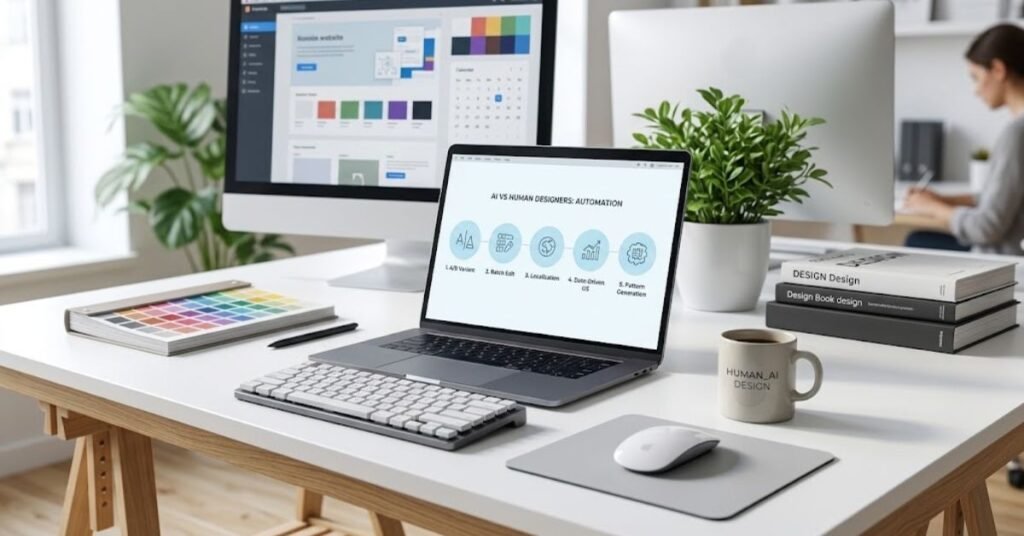
While human professionals remain essential for strategy and brand building, AI tools outperform humans in specific technical and repetitive tasks:
- A/B Testing Variant Creation: Producing 50 minor variations of a promotional banner for split-testing campaigns in minutes.
- Automated Batch Processing: Cleaning backgrounds, adjusting shadows, and cropping thousands of catalog images automatically.
- Multi-Language Asset Localization: Adapting text fields and visual elements across dozens of localized banner sizes instantly.
- Data-Driven Layout Recommendations: Analyzing large conversion datasets to suggest optimal call-to-action placements.
- Pattern and Texture Generation: Rendering complex background textures, vector patterns, and abstract elements on demand.
Why “AI Slop” is a Real Business Risk
As accessible AI generators flood the internet, many businesses fall into the trap of publishing raw, unedited AI art and layouts. This practice has created a category of low-quality graphics commonly referred to as “AI slop.”
Publishing unrefined AI graphics poses several severe business risks:
- Erosion of Customer Trust: Modern internet users easily recognize generic AI imagery. Unnatural textures, distorted background elements, and floating text fragments harm brand credibility instantly.
- Generic Market Appearance: When competing brands use identical AI prompts and stock engines, their marketing materials begin to look identical, destroying competitive advantage.
- Legal and Copyright Ambiguities: Generative AI models train on vast public datasets. Relying on raw AI output creates potential intellectual property and trademark compliance risks.
- Poor Usability and Accessibility: AI engines focus on visual aesthetics rather than functional hierarchy, often resulting in unreadable text overlay, poor color contrast, and confusing layouts.
The Cost and Speed Reality
Making informed software and staffing decisions requires evaluating the time and financial trade-offs between AI platforms and human creative professionals.
Production Speed Comparison
- AI Design Platforms: Concept to draft asset within 5 to 10 minutes. Best suited for quick daily social posts or background asset cleanup.
- Human Designers: Concept to final production asset within 24 hours to 5 business days. Essential for core brand assets, primary landing pages, and complex user interfaces.
Financial Investment
- AI Tool Stack: $20 to $200 per month for multi-tool software subscriptions.
- Freelance Human Designer: $35 to $150 per hour based on experience and specialization.
- Professional Design Agency: $2,000 to $15,000+ per project or ongoing monthly retainer.
Side-by-Side Comparison: AI vs. Human Designers
To help you choose the right approach for your operational goals, consider how both options compare directly across primary creative dimensions:
| Comparison Factor | AI Design Tools | Human Designers |
| Primary Advantage | Unmatched output speed and low unit cost | Strategic vision, UX empathy, and original brand storytelling |
| Ideal Operational Use | Bulk ad variants, product background removal, initial ideas | Complete brand launches, complex UI/UX designs, custom campaigns |
| Creative Originality | Low to Medium (Recombines existing data) | High (Constructs novel, intentional visual solutions) |
| Detail Execution | Prone to subtle flaws (hands, text rendering) | Meticulous attention to typography, alignment, and grid systems |
| Brand Loyalty Build | Weak (Produces generic, impersonal visuals) | Strong (Builds authentic emotional connections with users) |
Hybrid Approaches: The Best of Both Worlds
The most efficient digital brands do not choose between AI tools and human creators. Instead, they establish a collaborative hybrid pipeline where human designers utilize AI tools to eliminate repetitive tasks and accelerate their creative output.
In a structured hybrid workflow, production moves through two distinct phases:
Phase 1: AI-Powered Ideation and Processing
The pipeline begins with artificial intelligence handling speed-intensive operations. Designers use AI generators to create initial mood boards, generate background textures, remove product image backgrounds, and brainstorm diverse layout directions.
Phase 2: Human Refinement and Strategic Execution
An experienced human designer takes the raw assets, filters out low-quality variations, and executes the final strategic assembly. The designer corrects typography, aligns UI elements with brand guidelines, optimizes mobile responsiveness, and ensures the design meets user experience standards.
This hybrid approach drastically reduces production timelines while maintaining the quality, brand voice, and user experience standards required for high conversions.
What Is Happening to Design Jobs?
The rapid adoption of automated tools is evolving the roles of creative professionals rather than making them obsolete.
Designers as Creative Directors and Strategists
Designers are spending less time on manual asset cropping, grid alignment, and repetitive formatting. Instead, their roles are shifting toward strategic direction, user journey optimization, prompt engineering, and visual quality control.
AI as an Integrated Co-Pilot
Modern graphic and web software now integrates AI assistants directly into standard toolbars. Rather than replacing human creators, these assistants serve as efficient digital helpers that execute manual commands through natural language prompts.
Who Should Use AI and Who Should Hire a Human?
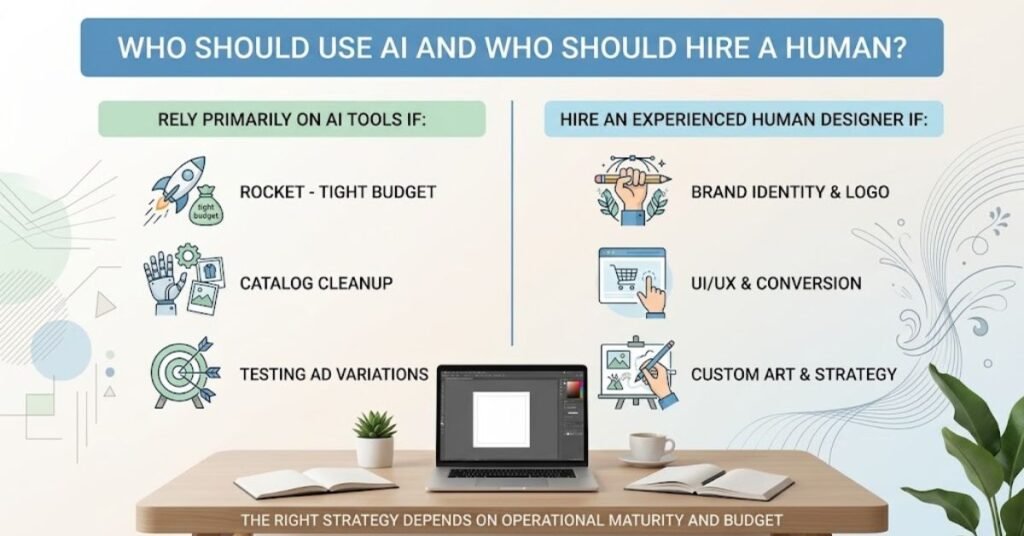
Selecting the right strategy depends on your operational maturity, available budget, and long-term business goals.
Rely Primarily on AI Tools If:
- You operate a early-stage business with a tight budget needing immediate social media assets.
- You need to clean, crop, or enhance large catalogs of product photography quickly.
- You are testing multiple digital ad variations to find winning marketing angles before investing in formal campaigns.
Hire an Experienced Human Designer If:
- You are launching a new brand identity, custom logo system, or flagship product line.
- You are redesigning your e-commerce store’s UI/UX to lower cart abandonment and improve conversion rates.
- Your marketing strategy requires custom illustrations, authentic brand photography, or specialized multi-platform interfaces.
Frequently Asked Questions
Will AI fully replace human web designers by 2026?
No. While AI tools handle repetitive layout generation and asset processing efficiently, human designers remain essential for strategic user experience planning, brand storytelling, custom interaction design, and empathetic problem-solving.
What is the single biggest limitation of AI in design?
The main limitation of AI design is its lack of human empathy and real-world context. AI generates graphics based on statistical patterns in existing datasets without understanding your target audience’s emotional triggers, brand values, or specific business objectives.
How can human designers use AI to improve their workflow?
Human designers can leverage AI for rapid wireframing, mood board creation, background removal, dynamic asset resizing, and batch-producing social media variations, allowing them to focus more time on high-level design strategy.
Are raw AI-generated graphics safe for commercial brand use?
While AI visuals can be used commercially, businesses must navigate ambiguous copyright laws, verify dataset usage terms, and edit raw assets thoroughly to avoid publishing generic graphics or violating intellectual property guidelines.
The Bottom Line
Artificial intelligence has permanently transformed the visual design landscape, delivering remarkable speed and asset volume. However, speed alone does not build a trusted, memorable brand or guide a customer effortlessly through a purchase funnel.
To achieve sustainable growth and maximize ad performance, use AI tools to handle repetitive processing and accelerate ideation, but rely on human design expertise to define your brand identity, refine user experience, and build authentic connections with your target audience.

Muhammad Talha breaks down complex AI tools into simple, step-by-step guides for e-commerce entrepreneurs. His goal: to help you work smarter, not harder, by leveraging artificial intelligence