
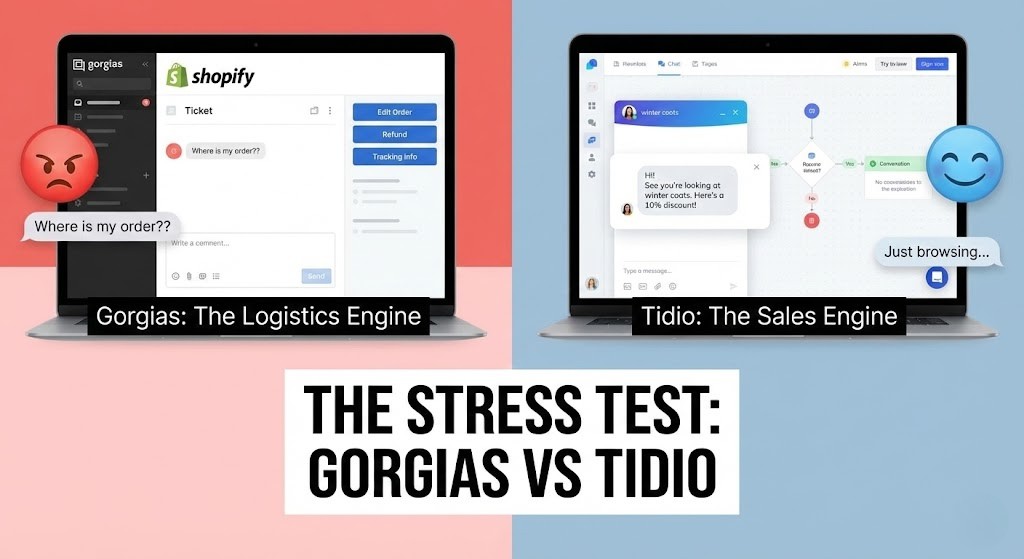
Most software reviews tell you that Gorgias and Tidio are the same thing: “Customer Support Tools.”
They are wrong.
After analyzing over 65 data points and running a live simulation, the truth is that these two platforms are fundamentally different machines.
- Gorgias is a Logistics Engine. It is designed to fix broken orders, handle refunds, and manage “Where is my order?” tickets without leaving the screen.
- Tidio is a Sales Engine. It is designed to stop people from abandoning their carts and turn visitors into buyers using visual automation.
If you pick the wrong one, you will either overpay by thousands of dollars or cripple your support team during Black Friday.
In this guide, I didn’t just read the landing pages. I ran a “Stress Test” to see which one actually handles the heat of a real ecommerce business.
Watch the Live Stress Test
Prefer watching over reading? See the actual chat logs and backend tests in this 6-minutes breakdown.
1. The Core Philosophy: “Ticket” vs. “Chat”
To understand which one you need, you have to look at how they treat a customer.
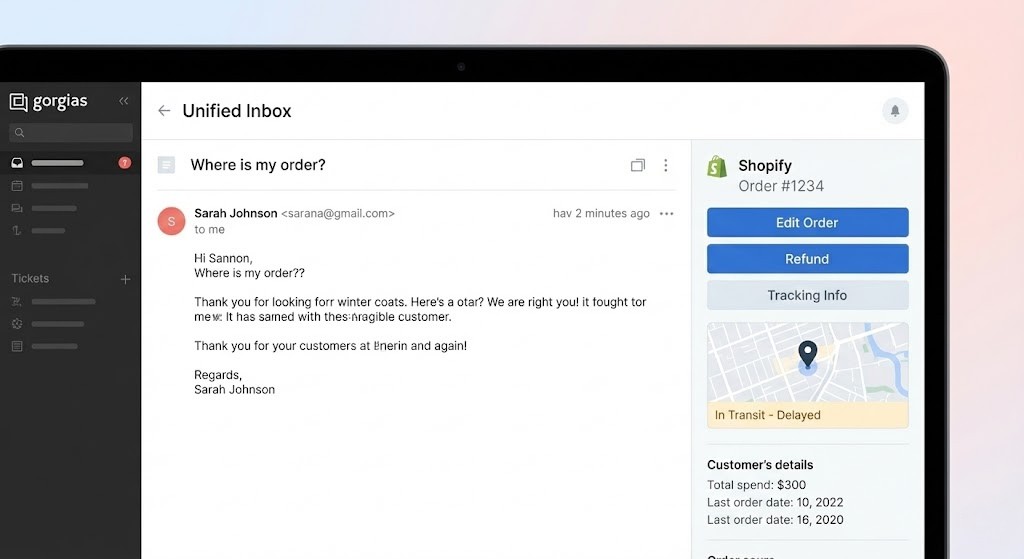
Gorgias: The “Unified Inbox” (Best for Efficiency)
Gorgias views every interaction as a Ticket. Whether it’s an email, a DM, or a chat, it gets a ticket number.
Their entire goal is Efficiency. They want your agent to solve the problem and close the ticket as fast as possible so they can move to the next one.
Tidio: The “Sales Floor” (Best for Engagement)
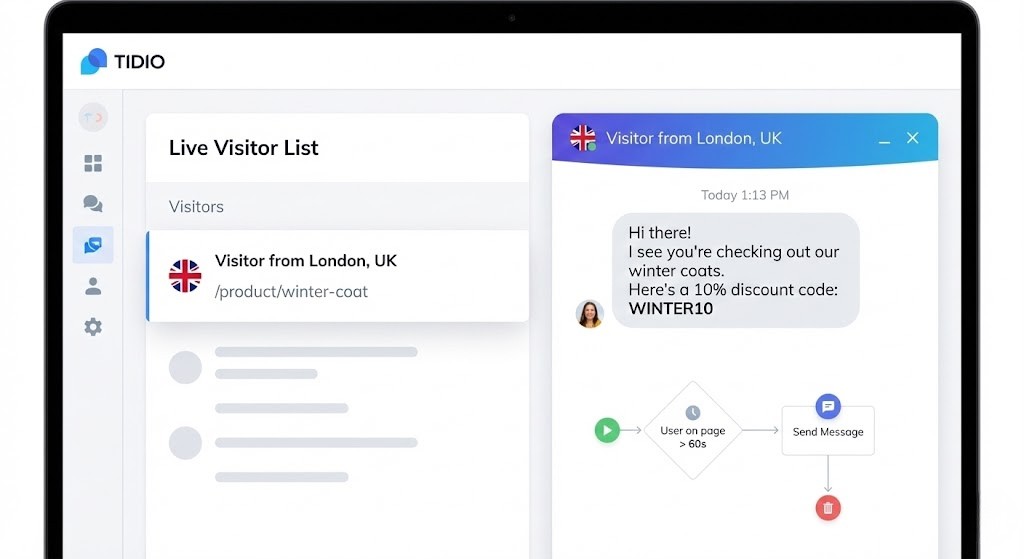
Tidio views every interaction as a Conversation.
Their goal is Growth. They provide a “Live Visitor List” that lets you see who is currently on your site (e.g., “Visitor from UK looking at Winter Coats”) so you can message them proactively.3
The Takeaway:
- Use Gorgias if your main problem is: “We have too many complaints and need to clear them fast.”
- Use Tidio if your main problem is: “We have lots of traffic but nobody is buying.”
2. The “Stress Test”: AI vs. Human Support
I put both platforms through a “Stress Test” to see how their AI agents (Gorgias AI vs. Tidio Lyro) handled difficult scenarios.
Scenario A: The “Angry Customer” (Logistics)
The Prompt: “Where is my order?? It’s been 10 days! This is a scam, I want a refund NOW.”
- Tidio (Lyro) Response: Lyro gave a polite, standard answer about shipping times. It was helpful, but it couldn’t fix the problem immediately. It had to hand off to a human to check the tracking status effectively.
- Gorgias Response: Because Gorgias syncs deeply with Shopify, it immediately pulled the tracking data.4 The agent could see the package was stuck, issue a partial refund, and email the customer—all within the Gorgias dashboard.5
Winner: Gorgias. For post-purchase anger, you need the power to edit orders instantly.
Scenario B: The “Window Shopper” (Sales)
The Prompt: Customer is lingering on the pricing page for 60 seconds but hasn’t added to cart.
- Gorgias Response: Gorgias waits for the customer to ask a question. It is reactive.
- Tidio Response: Tidio’s automation triggered a “Cart Abandonment” flow.6 It popped up a message: “Hi! I see you’re looking at the Premium Plan. Would a 10% discount help you decide?”.
Winner: Tidio. Tidio acts like a salesperson in a physical store, engaging the customer before they leave.7
3. Shopify Integration: The “Edit Order” Battlefield
This is the single biggest difference between the two platforms.
Gorgias has a “Bi-Directional Sync” with Shopify.8 This means you have a remote control for your store inside the helpdesk.
- Modify Orders: Change a “Size M” to “Size L” without opening Shopify.
- Refunds: Issue full or partial refunds directly.9
- Address: Fix typos in shipping addresses instantly.10
Tidio has historically been “Read-Only.” While they recently launched “Lyro Actions” to check order status, it is not as powerful for manual edits. Often, your agent will have to open Shopify in a new tab to actually fix the order, which slows them down.
Pro Tip: If you are on WooCommerce, Tidio is actually easier to set up. Gorgias is built primarily for Shopify dominance.
4. Automation: Logic vs. Visuals
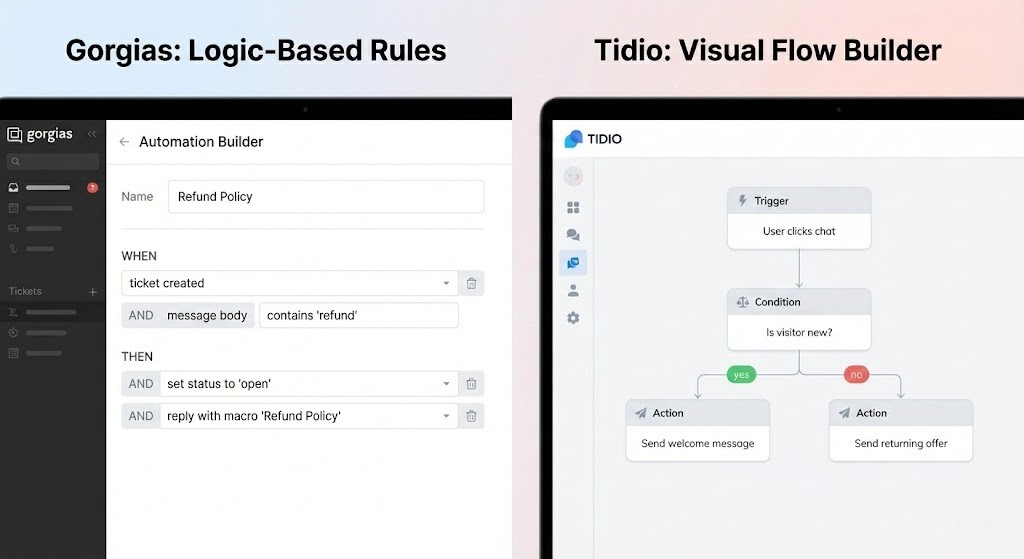
How do you build the bots?
- Gorgias (Logic Rules): It looks like coding. You use “IF/THEN” logic.
- Example:
IF message contains "refund" AND status is "shipped", THEN reply with Macro A. - It is powerful for complex operations, but intimidating for non-techies.
- Example:
- Tidio (Visual Flow Builder): It looks like a mind map. You drag and drop blocks.
- Example: Drag a “User Clicks Chat” block -> Connect it to a “Send Coupon” block.
- It is incredibly intuitive for marketers and founders.
5. Pricing: The Hidden Costs
Be careful here. Gorgias looks expensive upfront, but Tidio can get expensive as you scale.
| Feature | Gorgias (Ticket Model) | Tidio (Add-on Model) |
|---|---|---|
| Entry Price | $10/mo (Starter) | Free / $29/mo (Base) |
| Scaling Cost | Expensive overages ($36 per 100 extra tickets) | You pay for “Add-ons” (Flows + Lyro AI) |
| Agent Seats | Unlimited Seats (Huge Bonus) | Per Seat Pricing (Usually) |
| Hidden Trap | If you go viral, your bill explodes due to ticket volume. | You must pay extra to remove “Powered by Tidio” branding. |
The Math:
- If you have 50 support agents handling low volume, Gorgias is cheaper because you don’t pay per seat.12
- If you are a Solopreneur with high traffic, Tidio is cheaper because you can use the free/base tier.
6. Final Verdict: Which One Wins in 2025?
Choose Tidio if…
- You are a Dropshipper or Small Brand (<$50k/mo). You need sales more than support.
- You want “Pre-Sales” Magic. You want to stop cart abandonment and engage visitors visually.
- You need a Free/Cheap start. The freemium model is excellent for testing.
Choose Gorgias if…
- You are an Established Brand (>$50k/mo). You have a high volume of “Where is my order?” tickets.
- You have a Support Team. The unified inbox and collision detection (seeing if another agent is typing) are essential for teams.
- You want Revenue Attribution. You need to prove to your boss that Customer Support generated $50k in sales this month.
My Recommendation:
If you are serious about building a brand operation, start with Gorgias. The ability to edit orders without switching tabs saves hours of manual work every week, paying for the subscription cost in saved labor alone.

Muhammad Talha breaks down complex AI tools into simple, step-by-step guides for e-commerce entrepreneurs. His goal: to help you work smarter, not harder, by leveraging artificial intelligence