
Moving Beyond One-Off Prompts
You know the drill. Another product lands in your inventory. Another blank screen stares back at you.
Your mental checklist kicks in:
- “Need a product description… again.”
- “The weekly newsletter is due… what do I even say this time?”
- “We’re launching a new collection… that’s 50 new ads and social posts to write.”
It’s the endless, repetitive grind of e-commerce content creation. You’re stuck on a hamster wheel, churning out product descriptions, email sequences, and ad copy, one at a time. It’s tedious, time-consuming, and utterly unscalable. Sure, you’ve tried using AI—dashing a quick prompt into ChatGPT—but the results feel generic, inconsistent, and… well, robotic. It’s just a faster way to create mediocre content.
But what if you could stop the cycle for good?
What if you could stop reacting to every new content task and start systemizing it all?
Effective AI for ecommerce isn’t about using random, one-off prompts as a fancy shortcut. That’s just digital duct tape. True power comes from building a repeatable, scalable system—a “Content Engine.”
This is the ultimate guide to building that engine. In the following sections, you won’t just get a few clever prompts. You will get a complete, battle-tested framework to automate the heart of your e-commerce copy. We’re talking about a proven system for product descriptions that sell, marketing copy that grabs attention, and email sequences that build relationships and drive revenue—all while perfectly preserving your unique brand voice.
Here’s what you’ll walk away with:
- A Step-by-Step Framework: From laying your brand foundation to executing with precision.
- Proven Prompts for Every Content Type: Ready-to-use templates for descriptions, ads, and emails.
- Quality Control Strategies: How to edit, refine, and beat the “AI blandness” to ensure your content always sounds like you.
Let’s shift from being a frantic content writer to a strategic content engineer. Let’s build your engine
Part 1: Why a System Beats One-Off Prompts in E-Commerce
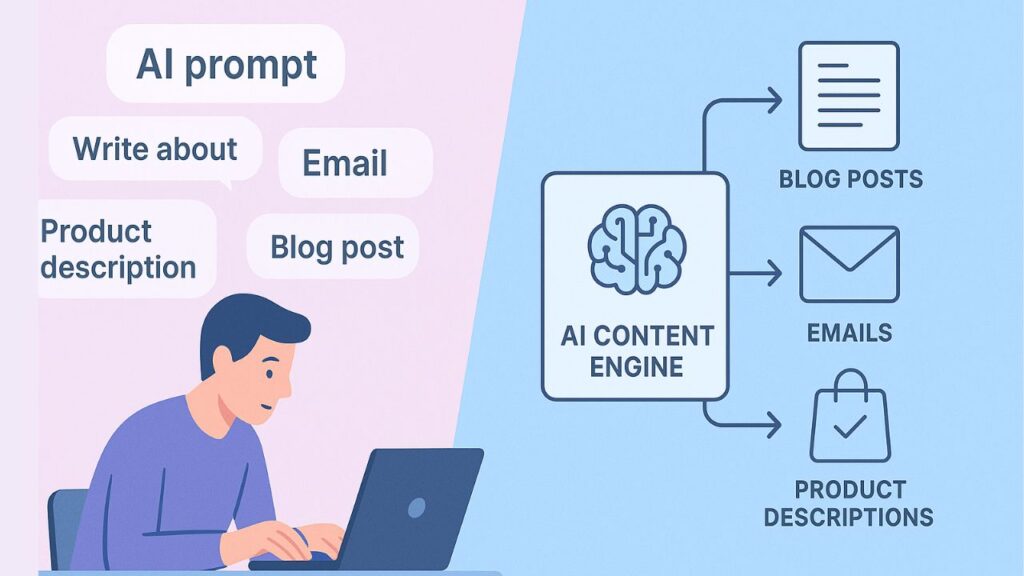
So, you’ve experimented with AI. You’ve pasted a product name into a chatbot and gotten a decent description back. It felt like magic. But then you tried it for an email, and the tone was off. Then for an ad, and it sounded just like your competitor’s. This is the critical juncture where most e-commerce stores stall out. They have the tool but lack the methodology.
Understanding this difference—between random usage and a strategic system—is what separates brands that get mediocre results from those that fully leverage AI for ecommerce to achieve massive scale.
The Limitation of Random AI Use
Treating AI like a magic wand for individual tasks might seem efficient at first, but it quickly leads to three major problems that can hurt your brand and your bottom line:
- The Inconsistent Brand Voice: When you use a new, isolated prompt for every piece of content, the AI has no memory of your brand’s personality. Is your voice witty and irreverent? Professional and authoritative? Without a system, your AI-generated product descriptions might sound corporate, while your emails come off as overly casual, confusing your customers and diluting your brand identity. You’re essentially creating a choir of singers who’ve never practiced together—it’s chaotic and unmistakably amateur.
- Factual Errors and “Hallucinations”: AI models are designed to generate plausible-sounding text, not to be databases of truth. When used randomly, they might invent product specifications, fabricate features, or use incorrect terminology. Calling a cotton shirt “moisture-wicking” might sound good, but it’s factually wrong and will lead to returns and damaged trust. A one-off prompt doesn’t force the AI to cross-check against your actual product data.
- The “AI Blandness” Epidemic: This is the most common complaint. When everyone uses the same basic prompts (“Write a product description for a [product]”), the output starts to sound generic and soulless. It lacks the unique spark, the specific customer insight, and the persuasive storytelling that makes copy truly convert. You end up with content that is “good enough” but never “great,” leaving money on the table and failing to build a memorable brand.
The Power of a Systemized Approach to AI for ECommerce
Now, let’s flip the script. A systemized approach isn’t about using different tools; it’s about using the same tools differently. It’s the difference between buying a single pre-made meal and building a fully-equipped kitchen with recipes you can use forever.
When you build a system, you transform your AI for ecommerce efforts from a chaotic gamble into a predictable, high-output engine. Here’s how:
- Massive Time Savings & Operational Efficiency: Instead of brainstorming and writing from scratch every time, you work from a library of pre-built, proven prompts. What used to take an hour per product description now takes minutes—for the first draft and the fiftieth. This frees you and your team to focus on high-level strategy, customer engagement, and business growth.
- Consistent Brand Messaging Across All Touchpoints: A system is built on a foundation of a well-defined “Brand Voice Guide” that you feed to the AI. This means every product description, every Facebook ad, and every welcome email will carry the same distinct tone, language, and personality. Your customer gets a unified experience, whether they’re reading your Instagram post or their order confirmation email, building immense trust and brand recognition.
- Effortless Scalability for Launches and Growth: This is the game-changer. Imagine launching 50 new products. The old way would be a month of copywriting hell. With a systemized AI for ecommerce engine, you simply plug your new product data into your established frameworks and generate 90% of the content in an afternoon. This allows you to scale your content production linearly with your business growth without needing to scale your stress levels or your team’s workload.

The Ultimate Guide to Measuring the ROI of AI Content in E-Commerce
Learn how to measure ROI of AI content in e-commerce, track metrics, boost conversions, and maximize revenue with smart AI strategies.
| Aspect | One-Off Prompt Approach | Systemized AI Engine |
|---|---|---|
| Brand Voice | Inconsistent and chaotic | Unified and professional |
| Accuracy | Prone to errors and “hallucinations” | Reliable and fact-checked |
| Efficiency | Saves time on a single task | Saves hundreds of hours at scale |
| Output Quality | Often generic (“AI Bland”) | Consistently high-quality and on-brand |
| Scalability | Difficult and messy | Easy, repeatable, and effortless |
By moving to a system, you stop being a frantic prompt-typer and start being a strategic director. You’re not just using AI; you’re orchestrating it. In the next section, we’ll lay the first bricks of this system by building your brand’s AI foundation.

How to Build AI Prompt Templates for Consistent E-Commerce Copy
Learn how AI prompt templates help create fast, consistent e-commerce copy that boosts SEO, saves time, and strengthens your brand.
Part 2: Building Your Brand’s AI Foundation
Think of your AI system as a new, incredibly talented junior copywriter. They’re fast and eager to please, but they don’t know your brand’s personality, your products’ unique details, or what makes your customers tick. If you just throw random tasks at them, the results will be messy and inconsistent.
This is the step most people skip in their rush to generate content, and it’s the single biggest reason their AI for ecommerce efforts fail. You must invest time in the foundation. In this section, we’ll train your AI, giving it the context and rules it needs to produce exceptional, on-brand content every single time.
The First Step in AI for Ecommerce: Defining Your Brand Voice
Your brand voice is the personality of your business. It’s how you connect with customers on an emotional level. Without a clear definition, your AI will default to a generic, corporate tone that sounds like everyone else. The solution is to create a simple, one-page “Brand Voice Charter.” This document becomes the bible for all your AI interactions.
Here’s how to build yours in under 30 minutes:
- Identify 3-5 Core Adjectives: How do you want to sound? Choose descriptors that define your brand’s personality. Are you:
- Witty and Relatable? (e.g., Gymshark)
- Authoritative and Trusted? (e.g., Patagonia)
- Inspirational and Empowering? (e.g., Nike)
- Warm and Helpful? (e.g., Brooklinen)
- Define “Do’s” and “Don’ts”: Create clear, actionable guidelines.
- Do’s: “Use contractions (it’s, we’re).” “Incorporate storytelling.” “Address the customer as ‘you’.”
- Don’ts: “Avoid jargon and technical terms.” “Never use aggressive sales language.” “Stay away from clichés like ‘game-changing’.”
- Provide Example Phrases: Give the AI a taste of your specific language.
- Instead of: “This product is high-quality.”
- We say: “You’ll feel the difference from the very first use.”
Putting It Into Action: Your First Training Prompt
Now, you can use AI to help you define its own rules. Take your existing website “About Us” page, product descriptions, and mission statement, and use this prompt:
“Analyze the following brand description and website copy. Extract the top 5 rules that define this brand’s voice and tone. Provide examples of phrasing that aligns with the voice.
Brand Context: [Paste your “About Us” text, mission statement, and a few paragraphs of your best existing copy here.]”
This prompt alone will give you a structured starting point for your Brand Voice Charter, ensuring your entire AI for ecommerce strategy is built on a consistent and authentic personality.
Gathering Your “Content Raw Materials”
Even the best-trained AI can’t work in a vacuum. Garbage in, garbage out. If you only give it a product name, it will invent generic features. Your job is to feed it the raw materials it needs to create accurate, specific, and persuasive content.
Before you write a single prompt, gather these essential inputs for each product:
- Manufacturer Specifications & Technical Details: This is the non-negotiable foundation. Provide precise data like dimensions, materials, weight, and ingredients. This prevents AI “hallucinations” and builds customer trust.
- Example Inputs: “100% organic Pima cotton,” “Battery life: 48 hours,” “Dimensions: 12″ x 8″ x 4″.”
- Unique Selling Propositions (USPs): What makes your product different and better than the competition? This is the heart of your persuasive argument.
- Example Inputs: “Our soap is hand-cut, not machine-pressed,” “Includes a lifetime warranty, unlike competitor’s 1-year offer,” “The only blender with a pulse-setting for perfect consistency.”
- Target Customer Pain Points: What problem does your product solve? What desire does it fulfill? Speak directly to this.
- Example Inputs: “Solves the frustration of tangled headphone cords,” “Addresses the fear of harsh chemicals in cleaning products,” “Fulfills the desire for a cafe-quality espresso at home.”
- Existing Positive Customer Reviews: This is your secret weapon. Reviews are pure, unfiltered social proof written in your customers’ language. They provide the emotional, relatable details AI often misses.
- Example Inputs: “Quote from review: ‘I was skeptical, but this mattress topper eliminated my back pain almost instantly,'” “Reviewer said: ‘My skin has never felt softer.'”
By combining a strong Brand Voice Charter with rich Content Raw Materials, you’ve just equipped your AI with everything it needs to succeed. You’ve moved from a random prompt generator to a strategic director. Now, let’s fire up the engine and put it all into practice.
Part 3: The AI for ECommerce Content Engine in Action

This is where the magic happens. You’ve laid the foundation—your Brand Voice is defined, and your raw materials are gathered. Now, it’s time to start the engine. In this section, we’ll plug your unique assets into proven, plug-and-play prompt frameworks to generate high-converting content across your entire store. This is the practical application of AI for ecommerce that will save you countless hours and drive real revenue.
Automating High-Converting Product Descriptions
Product descriptions are the workhorses of e-commerce. A great one sells; a generic one gets skipped. Let’s move beyond basic fact-listing and use strategic copywriting frameworks powered by AI. Lets try our free and 99.99% more productive product descripdtion grader
The AIDA Framework Prompt (Attention, Interest, Desire, Action)
AIDA is a classic marketing formula for a reason—it guides the customer on a psychological journey. Here’s how to implement it with your AI for ecommerce system.
Proven Prompt:
text
Act as a professional e-commerce copywriter for [Your Brand Name]. Using the AIDA framework, write a product description for [Product Name].

- **Attention:** Start with a compelling hook about [Customer Pain Point or Aspiration].
- **Interest:** Explain what makes this product special and how it works.
- **Desire:** Connect the features to the emotional benefits. Make the customer imagine their life improved by this product.
- **Action:** End with a clear, strong call-to-action to "Add to Cart."

**Product Details:**
- Key Features: [List 3-5 key features, e.g., "100% organic cotton," "Lightweight design," "10-hour battery life"]
- Key Benefits: [List the corresponding emotional benefits, e.g., "Feels soft and gentle on sensitive skin," "You'll barely notice you're wearing it," "Get through a full day of work without worrying about a charge"]
- Target Audience: [Describe your ideal customer, e.g., "Eco-conscious millennials," "Busy working professionals"]
- Brand Voice: [Reference your Brand Voice Charter, e.g., "Friendly, expert, and empowering"]
- Why This Works: This prompt structures the AI’s thinking. It forces it to go beyond features and tap into the emotions that drive purchases, which is the core of effective AI for ecommerce copy.
The Problem-Agitate-Solution (PAS) Framework Prompt
PAS is brutally effective because it focuses on a customer’s problem and amplifies their frustration before presenting your product as the hero.
Proven Prompt:
text
Using the Problem-Agitate-Solution (PAS) framework, write a product description for [Product Name] that addresses the pain point of [Customer Pain Point].

- **Problem:** Clearly state the problem your target customer faces.
- **Agitate:** Dig into the emotional consequences and frustrations of that problem. Make it relatable.
- **Solution:** Introduce your product as the direct solution. Explain how its features resolve the agitations.

**Incorporate the following specifics:**
- USP: [Your Unique Selling Proposition, e.g., "The only product with X technology"]
- Social Proof: [Include a short, powerful quote from a customer review]
- Tone: [Your Brand Voice, e.g., "Direct, empathetic, and solution-oriented"]
Pro-Tip: Don’t just generate one description. Use these prompts to create 2-3 variants for A/B testing. Change the hook or the primary benefit to see which one resonates most with your audience and drives more conversions.
Generating Marketing Copy that Stops Scrollers
In the fast-scrolling world of social media and search ads, you have seconds to capture attention. Your AI needs to be a master of brevity and impact.
Facebook/Instagram Ad Copy
The goal here is to stop the scroll with a strong hook and drive a specific action.
Proven Prompt:
text
Write 3 distinct versions of Facebook/Instagram ad copy for [Product/Offer, e.g., "Our new Summer Collection" or "20% Off Sitewide"].

- **The Hook:** Each version must start by targeting the specific pain point of: [e.g., "Tired of your phone dying by noon?"].
- **Body:** Briefly highlight the key benefit: [e.g., "All-day battery life without the heavy weight"].
- **CTA:** Include a strong call-to-action like "Shop Now," "Discover More," or "Claim Your Discount."
- **Tone:** Write in a [Your Brand Tone, e.g., "Casual and energetic"] voice.
- **Emojis:** Incorporate 1-2 relevant emojis naturally.
- Why This Works: It gives you ready-to-test options and ensures your ad speaks directly to a customer’s immediate need, which is a powerful AI for ecommerce advertising strategy.
Google PPC Headlines & Descriptions
For Google Ads, precision and keyword integration are king, all within strict character limits.
Proven Prompt:
text
Generate 5 Google Ads headline and description pairs for [Product Category, e.g., "wireless headphones"].

- **Primary Keyword:** Ensure the headline includes the keyword: "[Keyword, e.g., wireless earbuds]".
- **USP:** Highlight our unique selling proposition: "[Your USP, e.g., "With 48-hour battery life"].
- **Urgency/Benefit:** In the descriptions, include a key benefit and a subtle urgency or CTA.
- **Character Limits:**
  - Headlines: Max 30 characters each.
  - Descriptions: Max 90 characters each.
- Why This Works: This prompt respects the platform’s technical constraints while forcing the AI to focus on your core differentiator, making your AI for ecommerce PPC efforts more efficient and effective.
Writing Email Sequences that Build Relationships & Drive Sales
Email is where you build a relationship. AI can automate the personal touch, ensuring no subscriber falls through the cracks.
The Welcome Series
A new subscriber is your hottest lead. Nurture them immediately with a structured sequence.
Proven Prompt:
text
Outline a 3-email welcome sequence for a new subscriber who signed up with a discount code.

- **Email 1: The Thank You & Offer**
  - Subject: A warm thank you + their discount code.
  - Body: Briefly welcome them, reiterate the value they'll get from your brand, and clearly state their discount.

- **Email 2: The Brand Story & Mission**
  - Subject: Not just another [product category] company.
  - Body: Share our "why." What's our mission? What problem are we obsessed with solving? Build an emotional connection.

- **Email 3: The Top Product Showcase**
  - Subject: Our most loved products... (hint: you have a discount!)
  - Body: Showcase 2-3 of your best-selling products, highlighting benefits and linking to them. Remind them of their active discount.

**Overall Voice:** Write all emails in a [Your Brand Voice, e.g., "Warm, authentic, and helpful"] tone.
The Abandoned Cart Recovery
This is low-hanging fruit. A gentle, strategic nudge can recover a significant percentage of lost sales.
Proven Prompt:
text
Draft a 2-email abandoned cart sequence for a customer who left [Product Name] in their cart.

- **Email 1: The Gentle Reminder (Send 1-4 hours later)**
  - Subject: Did you forget something? 😊
  - Body: Show a clear image of the product. Briefly restate its core benefit. Include a direct link back to the cart.

- **Email 2: The Urgency Nudge (Send 20-24 hours later)**
  - Subject: Your cart is waiting! (But stock is low...)
  - Body: Create subtle urgency (e.g., mention low stock, or that the cart expires). Address a potential objection like shipping costs or fit questions by linking to your FAQ or sizing guide.
By implementing these precise prompts, your AI for ecommerce engine will now be fully operational, producing a constant stream of high-quality, on-brand content for your store’s most critical channels. But our work isn’t done yet. To go from good to great, we need to talk about advanced strategies and quality control.

Step-by-Step Guide to Automating Email Marketing with AI
Automate your email marketing with AI. Boost engagement, personalize campaigns, and save time using smart automation tools.
Part 4: Advanced AI for ECommerce Strategies
You’ve built your engine and it’s running smoothly. But the final 10% of polish is what separates good AI content from great, conversion-crushing copy. At this advanced stage, you transition from being an AI operator to an AI editor-in-chief. This is where you inject the irreplaceable human touch that elevates your content and fully optimizes your AI for ecommerce engine for maximum performance and trust.
The Human-in-the-Loop Edit: From Good to Great
AI generates a fantastic first draft, but the final edit is your superpower. This “Human-in-the-Loop” model is the secret weapon of top brands leveraging AI for ecommerce. It combines AI’s speed with human intelligence, creativity, and nuance.
Implement this simple but powerful 4-point checklist on every piece of AI-generated content before it goes live:
- Check for Accuracy & Specificity:
- The AI Might Say: “This blender is powerful and durable.”
- You Should Edit To: “This blender features a 1500-watt peak motor that crushes frozen fruit and ice in seconds, backed by a 10-year warranty on the drive system.”
- Action: Cross-reference the output with your technical specs and product knowledge. Replace vague claims with concrete data.
- Inject Storytelling & Unique Insights:
- The AI Might Say: “This coffee is sourced from sustainable farms.”
- You Should Edit To: “Our coffee is sourced from the high-altitude slopes of Huehuetenango, Guatemala, where the Rodriguez family has been cultivating these heirloom beans using shade-grown methods for three generations.”
- Action: Add a sentence that only you, as the brand owner, can know—a story about the product’s origin, the founder’s inspiration, or a specific use case.
- Ensure Brand Voice & Emotional Connection:
- The AI Might Say: “This product is recommended for users seeking to enhance their wellness routine.”
- You Should Edit To (if your voice is “Witty & Relatable”): “Your future well-rested, glowing-skinned self is already thanking you for adding this to your cart.”
- Action: Read the copy aloud. Does it sound like your brand? Does it make the customer feel something? Rewrite sentences to match your Brand Voice Charter perfectly.
- Add a Human “Spark”:
- Look for one place to add a personal touch: a relatable analogy, a bit of humor, or a conversational phrase. This breaks the “AI mold” and makes the content feel genuinely human.
SEO Optimization for Your AI-Generated Content
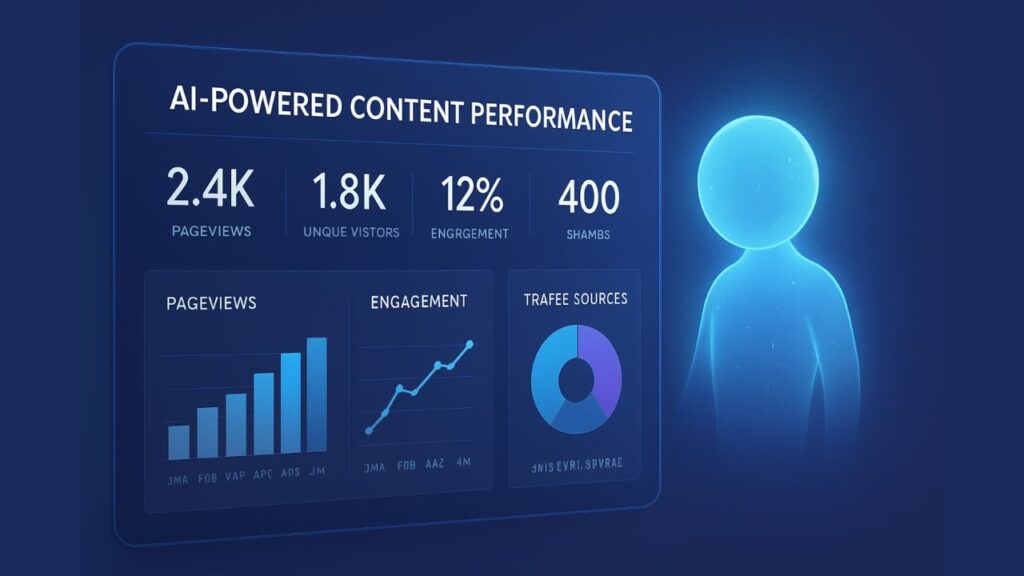
Your AI can write for humans, but it also needs to speak to search engines. A powerful AI for ecommerce strategy seamlessly blends persuasive copy with SEO best practices. The key is to bake SEO into the process, not just tack it on at the end.
- In the Prompt: The best way to get SEO-friendly content is to ask for it directly. Weave keywords into your prompts naturally.
- Example Addition to a Product Description Prompt: “…While writing, naturally incorporate the primary keyword
[e.g., "wireless workout earbuds"]in the first paragraph and use secondary keywords like["sweat-proof headphones", "gym earbuds"]elsewhere in the text where it flows naturally.”
- Example Addition to a Product Description Prompt: “…While writing, naturally incorporate the primary keyword
- In the Final Edit: After the AI generates the draft, do a quick SEO scan:
- Meta Data: Use your primary keyword in the page title (H1), meta title, and meta description.
- Headings: Structure your content using H2s and H3s that include relevant keywords.
- Natural Integration: Ensure keywords are placed contextually. Never force them in; if it sounds awkward, rewrite it. Google’s algorithms are smart enough to understand context and user intent, so prioritize readability.

How to Optimize AI Generated Content for Top Google Rankings
Learn how to optimize AI generated content for top Google rankings using E-E-A-T, structured data, and smart SEO strategies.
Beating “AI Blandness” with Social Proof
This is arguably the most effective advanced tactic. Customer reviews are authentic, emotional, and packed with the specific language your target audience uses. They are the ultimate antidote to generic AI copy and a powerful trust signal for your AI for ecommerce engine.
Strategy: The Review-Integration Prompt
Don’t just show reviews in a separate widget; weave their powerful language directly into your product descriptions and ads.
Proven Prompt:
text
Rewrite the following product description to make it more compelling and authentic by integrating direct quotes from customer reviews.

**Original Product Description:**
[Paste the AI-generated draft here]

**Customer Review Quotes to Integrate:**
- "[Specific, emotional review quote, e.g., "I've tried everything for my back pain, and this mattress topper was a miracle!"]"
- "[Another short, powerful quote focusing on a benefit, e.g., "It made my old mattress feel like a luxury hotel bed."]"

**Goal:** Weave these quotes naturally into the description to highlight the key benefits of [Benefit 1] and [Benefit 2]. Maintain a [Your Brand Voice] tone throughout.
Real-World Example:
- Bland AI Version: “Our coffee grinder provides a consistent grind size for a better-tasting brew.”
- Supercharged with Social Proof: “Achieve a perfect, consistent grind every time for a richer flavor. But don’t just take our word for it—one customer raved, ‘I finally understand what people mean by a “balanced cup.” My morning coffee has never tasted this good!‘”
By implementing these three advanced strategies, you move from simply using AI to mastering it. You ensure your content is not only fast and scalable but also accurate, emotionally resonant, and perfectly optimized for both your customers and search engines. This is the final piece of the puzzle for a truly world-class AI for ecommerce content system.
Part 5: Your Implementation Roadmap
You now have the complete blueprint for a powerful AI Content Engine. But knowledge without action is just theory. This final section transforms everything you’ve learned into a simple, actionable plan. Follow this step-by-step roadmap to go from theory to results, and start leveraging the full power of AI for ecommerce in your business today.
Your 5-Step AI for ECommerce Implementation Plan
This isn’t about a complete overnight overhaul. It’s about consistent, smart progress. Tackle one step at a time, and within a week, you’ll have a fully operational system.
Step 1: Audit & Document (Day 1)
- Action: Don’t skip the foundation! Block 60 minutes to:
- Define Your Brand Voice: Create your one-page “Brand Voice Charter” with 3-5 core adjectives and dos/don’ts.
- Gather Raw Materials: Pick 3 of your products (a best-seller, a new product, and an underperformer). For each, gather the manufacturer specs, USPs, key customer pain points, and 2-3 powerful review snippets.
- Why This Works: This 60-minute investment prevents hundreds of hours of generic, off-brand AI content down the line. It’s the most critical step for effective AI for ecommerce.
Step 2: Start Small (Day 2)
- Action: Choose ONE content type to master first. We recommend product descriptions. Take the 3 products from Step 1 and run them through the AIDA or PAS framework prompts provided in Part 3.
- Why This Works: Focusing on one task prevents overwhelm. By generating 3 descriptions, you’re already proving the value of your new AI for ecommerce system and building confidence.
Step 3: Edit & Refine (Day 2)
- Action: Now, apply the “Human-in-the-Loop” checklist from Part 4 to each of the 3 AI-generated descriptions.
- Check for accuracy against your specs.
- Inject a specific detail or story.
- Tweak the language to perfectly match your brand voice.
- Add one human “spark.”
- Why This Works: This 10-minute edit per description is what transforms good AI drafts into great, conversion-ready copy. It ensures your content stands out and builds trust.
Step 4: Scale (Day 3-7)
- Action: Once you’re happy with your product description process, apply your mastered system to a new content type. Move on to either:
- Email Sequences: Generate your welcome series or abandoned cart emails.
- Marketing Copy: Create a batch of social media ad variants for a new campaign.
- Why This Works: You’re not starting from scratch. You’re using the same Brand Voice Charter and the same strategic prompt-building approach. This is how you achieve true scale with AI for ecommerce.
Step 5: Optimize (Ongoing)
- Action: This is where you unlock peak performance. For your key pages and ads, use your prompts to generate 2-3 distinct variants (e.g., one using AIDA, one using PAS). A/B test them to see which headline, hook, or story resonates most with your audience and drives more conversions.
- Why This Works: Your AI becomes a tireless testing engine, allowing you to data-optimize your copy constantly. This turns your AI for ecommerce content from a cost-saver into a profit-driver.
Conclusion: Launch Your Content Engine

Let’s take a moment to look at the journey. You started in the chaotic world of blank screens and endless content deadlines. You’ve now equipped yourself with a strategic, systemized framework—a true AI Content Engine. You’ve learned to build a foundation, train your AI, generate high-converting copy across multiple channels, and apply advanced edits to ensure quality.
You now hold the framework to save dozens, even hundreds of hours each month. More importantly, you have a scalable system that grows with your business, allowing you to launch new products and enter new markets with a content strategy that is both efficient and effective.
The only thing left to do is start.
Your Final CTA: Stop writing everything from scratch. Your future self—the one with more time, a growing business, and less stress—is waiting. Go back to Step 1, pick one product, and build your first AI-generated description using the prompts above.
Your Content Engine is built. Now, press start.
Download the Complete “AI for E-Commerce” Prompt Library
Looking to supercharge your online business with AI?
This exclusive 32-prompt PDF library gives you everything you need to create high-converting e-commerce content — from product descriptions and ad copy to email sequences, SEO prompts, and automation workflows.
Each prompt is designed with variables like [product name], [audience], and [tone], so you can quickly generate personalized, professional-quality marketing content using any AI tool.
Whether you’re a shop owner, marketer, or content creator, this resource will save you hours of work and help you scale your content engine fast.
🔽 Download Now
Click below to download your free copy of the full “AI for E-Commerce: 32 Complete Prompt Templates” and start optimizing your content today.
✨ SUPER BONUS: Prompt Optimization Checklist
(The ultimate checklist to transform your basic prompts into high-converting AI commands)
🔍 PRE-PROMPT PREPARATION
- Included specific context about my brand
“Added our Brand Voice Charter, USP, and product specifics” - Defined target audience clearly
“Specified demographics, pain points, and buying motivations” - Gathered all raw materials
“Collected product specs, customer reviews, and competitor insights”
🎯 PROMPT STRUCTURE OPTIMIZATION
- Specified desired output format/length
“Word count, bullet points, paragraphs, or specific sections” - Included brand voice guidelines
*”Added our 3-5 core adjectives and tone rules”* - Added relevant keywords for SEO
“Primary and secondary keywords placed naturally” - Provided examples of good output
*”Included 1-2 examples of copy we love”*
🚀 PERFORMANCE ENHANCEMENTS
- Set clear success criteria
“Defined what makes this prompt successful (conversions, clarity, etc.)” - Included CTAs where appropriate
“Added specific call-to-action language and placement” - Added personalization fields if needed
“{first_name}, {product_name}, {city} etc.” - Specified platform best practices
“Character limits, hashtags, or platform-specific formatting”
📊 QUALITY CONTROL CHECKS
- Added anti-generic safeguards
“Instructions to avoid clichés and AI blandness” - Included fact-checking requirements
“Cross-reference with product specs and data” - Set emotional connection goals
“Create specific emotional response in target audience” - Added A/B testing instructions
*”Generate 2-3 variants for testing different angles”*
🔄 WORKFLOW INTEGRATION
- Optimized for team collaboration
“Clear enough for team members to use consistently” - Included editing instructions
“Human-in-the-loop editing steps specified” - Added scaling potential
“Can this prompt be templatized for multiple products?” - Set up performance tracking
“How will we measure this prompt’s success?”
🎯 QUICK SCORING SYSTEM:
21-25 Checks: 🏆 PRO LEVEL – Your prompts will crush it
16-20 Checks: 🥈 ADVANCED – Strong, conversion-ready prompts
11-15 Checks: 🥉 INTERMEDIATE – Good foundation, needs polish
0-10 Checks: 🔰 BEGINNER – Start with the top 5 checks first
FAQs
Q1: How can I maintain a consistent brand voice when using AI for all my content?
A: This is the most common challenge, and the solution is your Brand Voice Charter. By creating a single document that defines your brand’s personality (with specific adjectives, dos/don’ts, and example phrases) and including it in your prompts, you train the AI to sound like you. The “Human-in-the-Loop” edit is your final quality check to ensure every piece of content is consistently on-brand before it goes live.
Q2: My products are very technical. How do I stop the AI from making factual errors or “hallucinations”?
A: Accuracy is non-negotiable. This is why the “Gathering Raw Materials” step is so critical. You must feed the AI precise, bullet-pointed data directly from your manufacturer specs, engineering notes, or product developers. Treat the AI as a brilliant copywriter who is not a subject matter expert—your job is to provide the facts, and its job is to frame them persuasively. Always fact-check the output against your source material.
Q3: Won’t my content sound generic if all my competitors are using the same AI tools?
A: It can, if you use basic, one-off prompts. The key is to use the advanced strategies we outlined. Beating “AI Blandness” involves injecting your unique brand voice, integrating specific customer reviews and stories, and using the “Human-in-the-Loop” edit to add insights only you have. Your competitors might get a first draft from AI; you will get a finished, polished piece of content that resonates uniquely with your audience.
Q4: Which type of content should I automate first with AI?
A: For most e-commerce stores, we recommend starting with product descriptions. They are numerous, repetitive, and have a direct impact on conversion rates. Mastering product descriptions first allows you to perfect your prompting and editing workflow on a contained task. Once that system is reliable, you can confidently scale to email sequences and marketing copy.
Q5: What is the realistic time-saving and ROI I can expect from implementing this AI system?
A: The time savings are dramatic. Manually writing a product description can take 30-60 minutes. With your AI Content Engine, you can generate a high-quality first draft in under 2 minutes and spend another 5-10 minutes editing it. This can cut your content creation time by 70-80%. The ROI comes from reallocating those saved hours to higher-value activities like strategy and customer engagement, while also scaling your content to improve SEO and drive more sales.

Muhammad Talha breaks down complex AI tools into simple, step-by-step guides for e-commerce entrepreneurs. His goal: to help you work smarter, not harder, by leveraging artificial intelligence