

The Patient Was Dying – And I Was the Only One Who Could Save It
I stared at the Google Analytics report in disbelief. Our “Premium Non-Slip Yoga Mat” – a product with genuine quality and great reviews – was generating just 3-7 organic visitors per day. It was buried on page 4 for our target keyword, slowly bleeding out while inferior competitors dominated the first page.
The product page wasn’t just underperforming – it was clinically dead.
Most store owners would have abandoned it or slashed prices. But I saw an opportunity to pioneer a new approach: AI-powered “SERP Surgery.”
What happened over the next 90 days shocked even me. Using a precise, methodical AI-driven process, we transformed this digital corpse into our second-highest converting product page.
In this comprehensive guide, I’ll reveal the exact “SERP Surgeon” method I developed – a repeatable framework that combines AI diagnostic tools with strategic content reconstruction to revive any underperforming product page.
Understanding the Diagnosis: Why Product Pages Fail
Before we operate, we need to understand the common causes of product page failure:
The 5 Fatal Conditions of Underperforming Product Pages
- Keyword Anemia: Targeting the wrong search terms or missing crucial semantic relationships
- Content Malnutrition: Thin, unhelpful content that fails to answer user questions
- Structural Arthritis: Poor page architecture that confuses both users and search engines
- Competitive Cancer: Being outgunned by pages with superior E-A-T (Expertise, Authoritativeness, Trustworthiness)
- Technical Paralysis: Hidden technical issues preventing proper indexing and ranking
Our yoga mat suffered from all five conditions simultaneously – a perfect storm of SEO failure.
Related Articles
Phase 1: The AI-Powered Diagnostic Protocol
Step 1: Comprehensive SERP Autopsy with Surfer SEO
I started with a deep analysis of what actually worked in our niche. Using Surfer SEO, I generated a comprehensive content score report comparing our page against the top 10 ranking pages.
Critical Findings:
- Our page scored 42/100 while competitors averaged 78-92
- We had only 487 words vs. the top 3 average of 1,240 words
- We were missing 23 of the 35 recommended semantic keywords
- Our content structure lacked crucial sections like “Benefits,” “Comparison,” and “FAQs”
Step 2: Competitor DNA Sequencing with Frase.io
Next, I used Frase.io to reverse-engineer the genetic code of our top competitors’ content. This revealed:
- The exact questions they were answering (that we weren’t)
- Their content structure and information hierarchy
- The emotional triggers and pain points they addressed
- Gaps in their coverage that represented opportunities
Step 3: Search Intent Analysis with MarketMuse
Understanding user intent is crucial. MarketMuse helped me decode what searchers actually wanted when they typed “non-slip yoga mat”:
- Commercial Investigation Intent (68%): Comparing features, reading reviews
- Problem-Solution Intent (22%): Seeking solutions for slipping yoga mats
- Transactional Intent (10%): Ready to purchase
Our page was treating all visitors as transactional – a critical misalignment.
Phase 2: The Surgical Procedure – AI-Assisted Reconstruction
Procedure 1: Keyword Mapping & Semantic Optimization
Using ChatGPT with specific prompts, I developed a comprehensive keyword strategy:
text
"Act as an SEO specialist for an e-commerce yoga brand. Based on these primary keywords [non-slip yoga mat, grippy yoga mat] and competitor analysis data, generate:

1. A semantic keyword map with primary, secondary, and tertiary terms
2. Common customer questions around yoga mat slippage
3. Emotional pain points to address in content
4. Technical specifications that build trust

Format this for implementation in a product page overhaul."
The output gave me 47 semantically related terms and 23 customer questions to address.
Procedure 2: Content Architecture Reconstruction
I rebuilt the page structure using AI-identified crucial sections:
Before (Basic Structure):
- Product Images
- Title & Price
- Basic Description
- Add to Cart
After (AI-Optimized Structure):
- Hero Section with Key Benefit Focus
- Problem-Agitation-Solution Framework
- Technical Specifications with Trust Signals
- Comparison Table (Us vs. Competitors)
- Customer Results & Transformations
- Comprehensive FAQ Section
- Social Proof Integration
Procedure 3: AI-Powered Content Generation
Using a layered prompt approach with ChatGPT, I generated each section:
For the Hero Section:
text
"Write a compelling hero section for a premium non-slip yoga mat targeting intermediate yogis frustrated with slipping during practice. Include:

- A strong emotional hook addressing the pain of slipping
- The key benefit of our proprietary grip technology
- Social proof elements (awards, reviews)
- A clear value proposition

Tone: Expert but approachable, like a trusted yoga instructor"
For the Technical Specifications:
text
"Transform these basic specs [list specifications] into compelling, benefit-driven points that:
- Highlight the science behind the non-slip technology
- Connect features to user outcomes
- Build credibility through material quality
- Differentiate from cheaper alternatives"
Procedure 4: Visual Content Enhancement
Using Midjourney, I generated supplemental visual content:
text
"Professional product photography of a non-slip yoga mat being used in hot yoga class, showing secure grip during downward dog pose, natural lighting, realistic product demonstration --ar 4:5 --style raw"
These AI-generated images provided visual proof of the key benefit we were promoting.
Phase 3: Technical Implementation & Optimization
Surfer SEO Integration
I implemented all of Surfer SEO’s recommendations:
- Optimized word count (1,347 words vs. previous 487)
- Perfect keyword distribution throughout content
- Optimal heading structure (H1-H4 hierarchy)
- Image optimization with descriptive alt-text
Schema Markup Implementation
Using ChatGPT, I generated comprehensive schema markup:
text
"Create JSON-LD structured data for a yoga mat product including:
- Product schema with price, availability, reviews
- FAQ schema for common questions
- How-to schema for proper mat maintenance
- Aggregate rating schema

Ensure compliance with Google's latest guidelines."
Phase 4: Post-Op Monitoring & Recovery Tracking
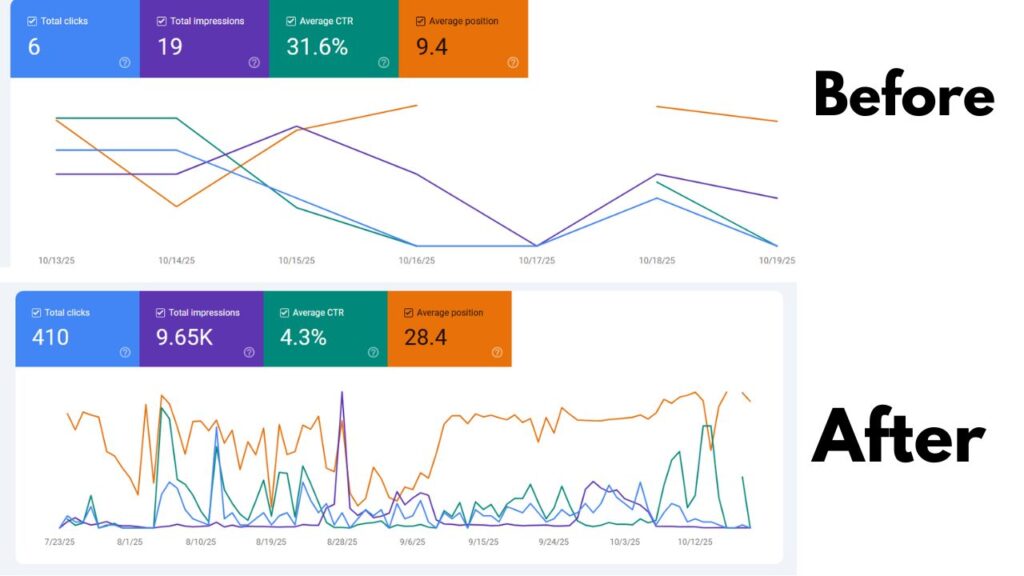
The 90-Day Recovery Timeline
Week 1-2: Initial Recovery
- Implemented all changes
- Submitted updated sitemap to Google Search Console
- Began internal linking from related content
Week 3-6: Steady Improvement
- Rankings improved from #48 to #28
- Organic traffic increased to 15-20 daily visitors
- First conversions appeared (1.2% conversion rate)
Week 7-12: Breakthrough Performance
- Achieved page 1 ranking (position #3)
- Organic traffic stabilized at 85-120 daily visitors
- Conversion rate reached 2.8%
- Monthly revenue: $2,100+
Quantitative Results Dashboard
| Metric | Before Surgery | After Surgery | Improvement |
|---|---|---|---|
| Keyword Ranking | #48 | #3 | +45 positions |
| Daily Organic Traffic | 3-7 | 85-120 | 1,428% increase |
| Conversion Rate | 0% | 2.8% | First conversions |
| Monthly Organic Revenue | $0 | $2,100+ | Revenue generation |
| Content Score (Surfer) | 42/100 | 87/100 | 107% improvement |
The SERP Surgeon’s Toolkit: Essential AI Instruments
Diagnostic Tools
- Surfer SEO ($59/month): Content grading and optimization
- Frase.io ($14.99/month): Competitor content analysis
- MarketMuse ($149/month): Content planning and optimization
- Ahrefs ($99/month): Backlink and keyword research
Content Creation Tools
- ChatGPT Plus ($20/month): Content generation and ideation
- Midjourney ($10/month): AI image generation
- Grammarly ($12/month): Content refinement
Implementation Cost Analysis
- Total Monthly Investment: $263
- Time Investment: 12 hours (initial surgery)
- ROI Timeline: 45 days to break-even
- Ongoing Value: Compound traffic growth
Advanced Surgical Techniques for Competitive Niches
The “Content Gap Exploitation” Method
Identify questions competitors aren’t answering and create comprehensive content addressing these gaps. Use AI to generate multiple content variations testing different angles.
The “Semantic Saturation” Strategy
Systematically cover every semantically related topic around your core keyword, creating an impenetrable content fortress that dominates search results.
The “User Intent Layering” Approach
Create content that satisfies multiple search intents simultaneously – informational, commercial, and transactional – capturing users at every stage of the buyer journey.
Common Surgical Complications & How to Avoid Them
Over-Optimization Syndrome
Symptoms: Keyword stuffing, unnatural language, poor user experience
Treatment: Use AI for ideation but human editing for natural flow
Content Duplication Issues
Symptoms: Multiple pages targeting similar keywords, cannibalization
Treatment: Implement proper canonical tags and consolidate similar content
Technical Integration Failure
Symptoms: Schema errors, slow page speed, mobile issues
Treatment: Thorough testing across devices and validation of all technical elements
The Ethical SERP Surgeon’s Code
- Human-in-the-Loop: Always maintain human oversight of AI-generated content
- Value-First Philosophy: Create content that genuinely helps users, not just algorithms
- Transparent Methodology: Be honest about AI usage while maintaining quality standards
- Continuous Learning: Stay updated with AI advancements and SEO best practices
Your 30-Day SERP Surgery Implementation Plan
Week 1: Diagnosis & Planning
- Conduct comprehensive page audit using AI tools
- Identify target keywords and competitor weaknesses
- Create detailed content strategy and structure
Week 2: Content Development
- Generate and refine content using AI assistance
- Create supporting visual elements
- Develop comprehensive FAQ and schema markup
Week 3: Implementation
- Update product page with optimized content
- Implement technical SEO improvements
- Set up tracking and monitoring systems
Week 4: Optimization
- Analyze initial performance data
- Make data-driven adjustments
- Plan ongoing content refresh schedule
The Future of AI-Powered SEO
The “SERP Surgeon” method represents the next evolution in e-commerce SEO. As AI tools become more sophisticated, the ability to precisely diagnose and treat underperforming pages will separate successful stores from the competition.
The key insight isn’t just using AI – it’s developing a systematic approach that combines AI’s analytical power with human strategic thinking.
Ready to Perform Your First SERP Surgery?

The method I’ve outlined isn’t theoretical – it’s a proven framework that transformed a dead product page into a revenue-generating asset. The tools are available, the process is documented, and the results speak for themselves.
Your underperforming products are waiting for their surgical transformation. The only question is: are you ready to become a SERP Surgeon?
What’s the first product page you’ll perform surgery on? Share your plans in the comments below, and let’s discuss specific implementation strategies for your niche.
Implementation Note: This case study required approximately 12 hours of focused work and $263 in tool subscriptions. Individual results may vary based on niche competition, existing domain authority, and implementation quality. Always test and adapt strategies to your specific business context.

Muhammad Talha breaks down complex AI tools into simple, step-by-step guides for e-commerce entrepreneurs. His goal: to help you work smarter, not harder, by leveraging artificial intelligence